NCERT Solutions • Class 6 Mathematics (Ganita Prakash) |
Get the simplifiedClass 6 Maths NCERT Solutionsof Ganita Prakash Chapter 5 Prime Time textbook exercise questions with complete explanation.
Ganita Prakash Class 6 Maths Chapter 5 Solutions Prime Time
1 Common Multiples and Common Factors Figure it Out (Page No. 108)
Question 1
Solution:
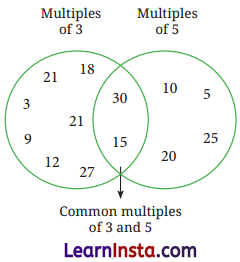
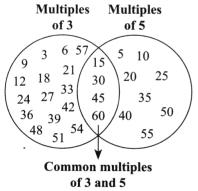
The first number for which the players should say, ‘idli-vada’ is 15 as 3 × 5, which is a multiple of 3 and 5.
So, 15 × 1 = 15, 15 × 2 = 30, 15 × 3 = 45, …………………. …………………. …………………. 15 × 10 = 150 Thus, 150 is the number that will be said ‘idli-vada’ for the 10th time. |
Question 2
|
(ii) The multiples of 5 from 1 to 90 are 5, 10,15, 20, 25, 30, 35,40, 45, 50, 55,60, 65, 70, 75, 80, 85 and 90.
Thus, the number of times, the children would say ‘vada’ is 18.
(iii) The multiples of 15 are 15, 30,45,60, 75 and 90. Thus, the number of times, the children would say ‘idli-vada’ is 6.
Question 3
|
Question 4
|
Intext Questions
Question 1
|
Question 2
|
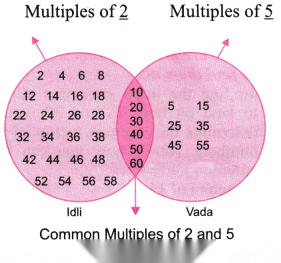
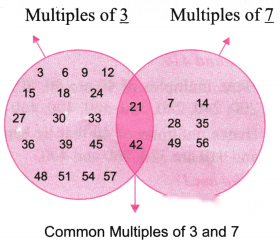
(b) 3 and 7
Solution:
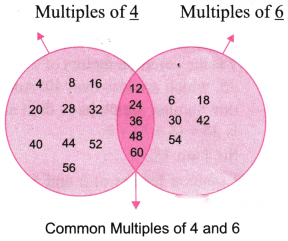
(c) 4 and 6
Solution:
Question 3
|
Question 4
|
Factors of 15:
Factors of 30:
The common factors between these two lists are: 1, 3, 5, 15. So, the jump sizes that will allow Jumpy to land on both 15 and 30 are the common factors of 15 and 30.
Therefore, the jump sizes that will enable Jumpy to land on both 15 and 30 are: 1, 3, 5, 15
Question 5
|
1 Common Multiples and Common Factors Figure it Out (Page No. 110 – 111)
Question 1
Solution:
Multiples of 40 that lie between 310 and 410 are 320, 360 and 400.
|
Question 2
|
(b) The number less than 100 whose two factors 3 and 5 are 15, 30, 45,60, 75, 90. Out of these numbers, the number 15 has one of digits is 1 more than the other.
Hencd, the number less than 100 whose two factors are 3 and 5 and one of digits is 1 more than the other is 15.
Question 3
|
A perfect number between 1 and 10 is 6. Its factors are 1, 2, 3, and 6 and the sum of all factors is 12 which is twice of 6.
Question 4
|
(b) Factors of 35 are 1, 5, 7, 35
Factors of 50 are 1, 2, 5, 10, 25, 50
So, the factors which are common to both of the given numbers are 1 and 5.
Therefore, the common factors are 1 and 5.
(c) Factors of 4 are 1, 2, 4
Factors of 8 are 1, 2, 4, 8
Factors of 12 are 1, 2, 3, 4, 6, 12.
So, the factors that are common to all of the given numbers are 1, 1, and 4.
Therefore, the common factors are 1, 2, and 4.
(d) Factors of 5 are 1 and 5.
Factors of 15 are 1, 3, 5 and 15.
Factors of 25 are 1, 5, and 25.
So, the factors which are common to all of the given numbers are 1 and 5.
Therefore, the common factors are 1 and 5.
Question 5
|
Question 6
|
Question 7
|
Question 8
|
Question 9
|
Question 10
|
2 Prime Numbers Figure it Out (Page No. 114 – 115)
Question 1
Solution:
No, 2 is the only even prime number.
|
Question 2
|
Question 3
|
No, there are not an equal number of primes occurring in every row in the table. The last row has the least number of primes and the first and second rows have the maximum prime numbers.
Question 4
|
Question 5
|
Question 6
|
Question 7
|
Question 8
|
Question 9
|
(b) (False)
No, a product of primes cannot be a prime.
e.g. 2 and 3 are prime numbers but 2×3 = 6, which is not a prime number.
When you multiply two or more primes, you get a composite number, which has divisors other than just 1 and itself.
(c) (False)
Prime numbers have factors but only two
i. e. 1 and the number itself.
e.g. Prime number 5 has only two factors 1 and 5.
(d) (False)
No, all even numbers are not composite numbers, e.g. 2 is an even prime number.
(e) (True)
2 is a prime followed by a prime number 3.
For every other prime, the next number is composite, e.g. 5 followed by 6, which is composite.
11 followed by 12, which is composite.
13 followed by 14, which is composite.
Question 10
|
Question 11
|
Question 12
|
Intext Questions
Question 1
|
Question 2
|
3 Co-prime Numbers for Safekeeping Treasures Figure it Out (Page No. 120)
Question 1
Solution:
|
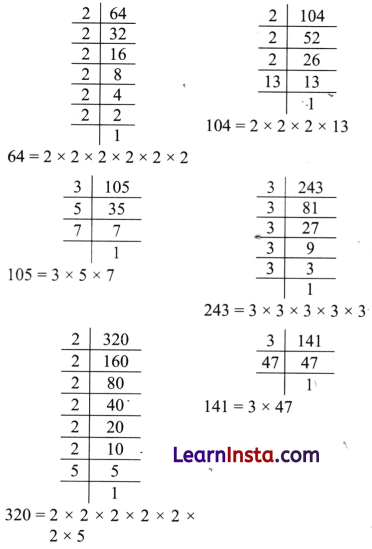
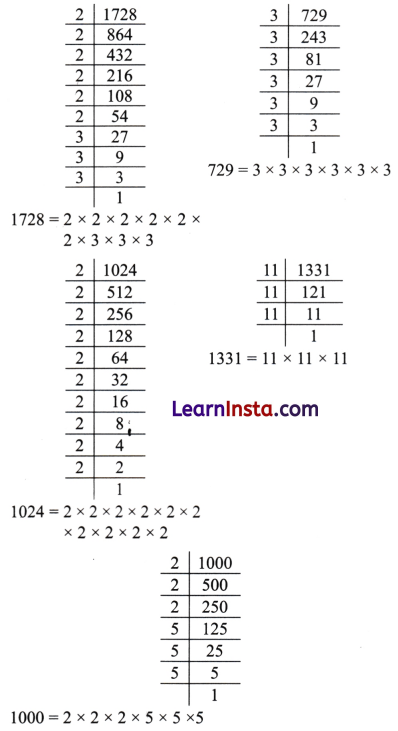
Question 2
|
Question 3
|

Question 4
|
(b) Given number is 108 × 75.
Prime factorisation of 108 = 2 × 2 × 3 × 3 × 3
Prime factorisation of 75 = 3 × 5 × 5
∴ Prime factorisation of 108 × 75
= 2 × 2 × 3 × 3 × 3 × 3 × 5 × 5
(c) Given number is 1000 × 81.
Prime factorisation of 1000 = 2 × 2 × 2 × 5 × 5 × 5
Prime factorisation of 81 = 3 × 3 × 3 × 3
∴ Prime factorisation of 1000 × 81
= 2 × 2 × 2 × 5 × 5 × 5 × 3 × 3 × 3 × 3
= 2 × 2 × 2 × 3 × 3 × 3 × 3 × 5 × 5 × 5

Question 5
|
(b) The smallest four prime numbers are 2,3,5 and 7.
Thus, the smallest number with exactly four different prime factors = 2 × 3 × 5 × 7 = 210
Intext Questions
Question 1
|
(b) We have factors of 15 = 1 × 3 × 5 and factors of 37 = 1 × 37
No common factor other than 1.
Hence 15 and 37 are co-prime numbers.
(c) Given numbers are 30 and 415 Here factors of 30 = 1 × 2 × 3 × 5 and factors of 415 = 5 × 83
Clearly 5 is a common factor of 30 and 415.
Hence 30 and 415 are not co-prime numbers.
4 Prime Factorisation Figure it Out (Page No. 122)
Question 1
Solution:
(a) 30 and 45
(b) 57 and 85 (c) 121 and 1331 (d) 343 and 216 Solution: (a) Factors of 30 and 45: 30 = 2 × 3 × 5, 45 = 3 × 3 × 5 Common factors: 3 × 5 = 15, hence 30 and 45 are not a pair of co-prime numbers. |
(b) Factors of 57 and 85:
57 = 3 × 19,
85 = 5 × 17
No common factors other than 1, hence 57 and 85 are a pair of co-prime numbers.
(c) Factors of 121 and 1331:
121 = 11 × 11,
1331 = 11×11×11
Common factors: 11 × 11 = 121, hence 121 and 1331 are not a pair of co-prime numbers.
(d) Factors of 343 and 216:
343 = 7 × 7 × 7,
216 = 2 × 2 × 2 × 3 × 3 × 3
No common factors other than 1, hence 343 and 216 are a pair of co-prime numbers.
Question 2
|
(b) The prime factorization of 96 is 2 × 2 × 2 × 2 × 2 × 3 and 24 is 2 × 2 × 2 × 3.
Yes, all the prime factors of 24 occur in the prime factorization of 96.
So, 96 is divisible by 24.
(c) The prime factorization of 343 is 7 × 7 × 7 and 17 is 1 × 7.
No, all the prime factors of 343 are different from the prime factors of 17.
So, 343 is not divisible by 17.
(d) The prime factorization of 999 is 3 × 3 × 3 × 37 and 99 is 3 × 3 × 11
No, 3 occurs thrice in the prime factorization of 999 but twice in the prime factorization of 99.
So, 999 is not divisible by 99.
Question 3
|
Question 4
|
5 Divisibility Tests Figure it Out (Page No. 125-126)
Question 1
Solution:
(a) Do it yourself.
(b) We know that leap years occur in the years that are multiples of 4, except century years. Therefore, multiples of 4 after 2024, will be 2028, 2032, 2036, 2040, 2044, 2048, 2052, 2056, 2060, 2064, 2068, 2072, 2076, 2080, 2084, 2088, 2092, and 2096, till 2099. Therefore, there will be 19 leap years from the year 2024 till 2099. |
Question 2
|
The largest 4-digit palindrome is 9999.
Checking divisibility by 4 9999 (not divisible by 4)
9889 (not divisible by 4)
9779 (not divisible by 4)
9669 (not divisible by 4)
9559 (not divisible by 4)
9449 (not divisible by 4)
9339 (not divisible by 4)
9229 (not divisible by 4)
9119 (not divisible by 4)
9009 (not divisible by 4)
8998 (not divisible by 4)
8888 (divisible by 4)
Therefore, the largest 4-digit palindromic number divisible by 4 is 8888.
Question 3
|
(b) Sum of two odd numbers gives a multiple of 4.
Solution:
Sometimes true. Sum of two odd numbers can indeed be even but not necessarily a multiple of 4. For e×ample, 1 + 5 = 6 which is not a multiple of 4 whereas 1+3 = 4, which is a multiple of 4. Similarly 7 + 5 = 12, which is a multiple of 4.
Question 4
|
(ii) When divided by 5
78 ÷ 5: Q= 15 andR = 3;
99 ÷ 5: Q = 19 and R = 4;
173 ÷ 5: Q = 34 andR = 3;
572 ÷ 5: Q = 114 and R = 2;
980 ÷ 5: Q= 196 and R = 0;
1111 ÷ 5: Q = 222 and R= 1;
2345 ÷ 5: Q = 469 and R = 0
Note: To find the remainder when dividing by 5, check how much the last digit exceeds the nearest ‘0’ or ‘5’.
(iii) When divided by 2
78 ÷ 2: Q = 39 and R = 0;
99 ÷ 2: Q = 49 and R = 1;
173 ÷ 2; Q = 86 and R = 1;
572 ÷ 2; Q = 286 and R = 0;
980 ÷ 2; Q = 490 and R = 0;
1111 ÷ 2: Q = 555 and R = 1;
2345 ÷ 2: Q= 1172 and R = 1.
Note: To find the remainder when dividing by 2, check if the given digits is even (remainder ‘0’) or odd (remainder ‘1’)-
Question 5
|
Question 6
|
Question 7
|
Intext Questions (Page 124)
Question 1
|
Question 2
|
Question 3
|
Question 4
|
CBSE 2026-27 Board Exam Preparation & Practice Papers
Free Chapter Notes & Question Bank by BoardExams.in