NCERT Solutions • Class 6 Mathematics (Ganita Prakash) |
Get the simplifiedClass 6 Maths NCERT Solutionsof Ganita Prakash Chapter 6 Perimeter and Area textbook exercise questions with complete explanations.
Ganita Prakash Class 6 Maths Chapter 6 Solutions Perimeter and Area
1 Perimeter Figure it Out (Page No. 132)
Question 1
Solution:
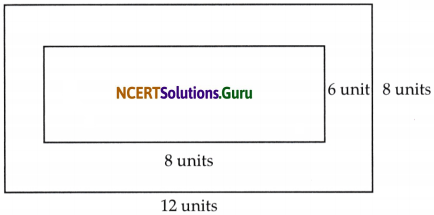
(a) Given, perimeter of rectangle =14 cm, breadth = 2 cm
Perimeter of rectangle = 2 (length + breadth) ⇒ 14 cm = 2 (length + 2 cm) ⇒ 7 cm = length + 2 cm ⇒ length = 5 cm |
(b) Given, perimeter of a square = 20 cm
⇒ 4 × side = 20 cm
⇒ side = 5 cm
Therefore, length of a side = 5 cm
(c) Perimeter of a rectangle = 12 m
⇒ 2 (length + breadth) = 12 m
⇒ 3 m + breadth = 6 m
⇒ breadth = 3 m
Question 2
|
Now, if we bend the wire to form a square, the total length of the wire (16 cm) will be divided equally among the four sides of the square.
So, each side of the square =
= = 4 cm
Question 3
|
Question 4
|
Question 5
|
Question 6
|
1 Perimeter Figure it Out (Page No. 133 – 134)
Matha Pachchi!
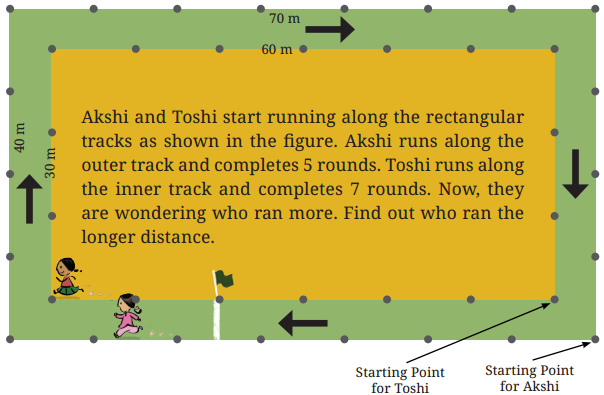
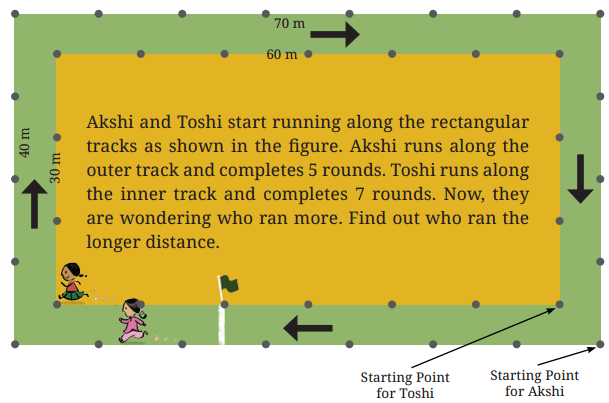
Each track is a rectangle. Akshi’s track has length 70 m and breadth 40 m. Running one complete round on this track would cover 220 m, i.e., 2 × (70 + 40) m = 220 m. This is the distance covered by Akshi in one round.
Question 1
Solution:
Akshi runs on a rectangular track with a length of 70 metres and a breadth of 40 metres.
∴ Perimeter of track = 2 × (length + breadth) = 2 × (70 + 40) = 220 m Since, the distance covered in one round = 220 m ∴ Total distance covered in 5 rounds = 5 × 220 m = 1100 m |
Question 2
|
Question 3
|
(b) Since the perimeter of the outer rectangle is 220 m, it implies that the distance covered till the starting point in 2 rounds will be 2 × 220 = 440 m
Now, the point where Akshi will cover 500 m will be 60 m away from this point.
(c) Distance covered by Akshi = 1000 m
No. of rounds = = 4 complete rounds and 120 m more.
Thus, she’ll be 120 m away from the starting point.
(d) Distance covered by Toshi in 1 round = 180 m
So, to cover 250 m, she’ll be 70 m away from the starting point.
(e) Since, the perimeter of the inner rectangle is 180 m, so to cover 500 m, Toshi will be taking 2 complete rounds and then she’ll have to move 140 m more i.e. 140 m away from the starting point.
(f) For 1000 m, Toshi will be covering = 5 complete rounds and 100 m more.
This means that she’ll be 100 m away from the starting point.
2 Area Figure it Out (Page No. 138)
Question 1
Solution:
Length of a rectangular garden = 25 m
Area of rectangular garden = length × width 300 sq m = 25 m × width ⇒ Width of the garden = = 12 m |
Question 2
|
Question 3
|
Question 4
|
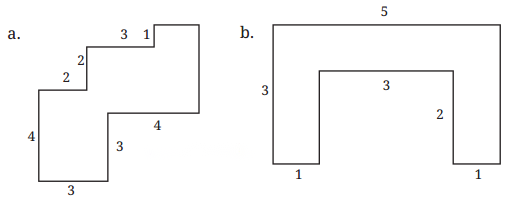
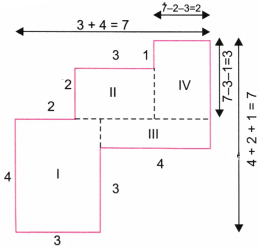
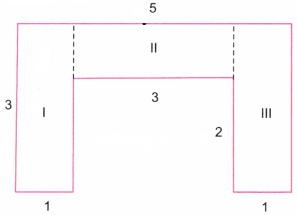
(b) Similarly, by splitting figure (b) into I, II, and III rectangles as shown in the figure below, we get
Area of the rectangle I = length × breadth
= 3 cm × 1 cm
= 3 sq. cm
Area of rectangle II = length × breadth
= 3 cm × 1 cm
= 3 sq. cm
Area of rectangle III = length × breadth
= 3 cm × 1 cm
= 3 sq. cm
The total area of the figure = 3 sq. cm + 3 sq. cm + 3 sq. cm = 9 sq. cm.
Therefore, the total area of Figure (b) is 9 sq. cm.
2 Area Figure it Out (Page No. 139)
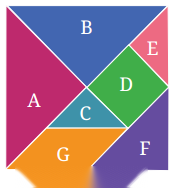
Cut out the tangram pieces given at the end of your textbook.
Question 1
Solution:
Here, we can see that some shapes have identical areas.
Specifically Shapes A and B These shapes are identical, meaning they cover the same amount of space, so they have the ^ same area. Shapes C and E These shapes also have the same area because they are identical in size and shape. |
Question 2
|
Question 3
|
Question 4
|
Question 5
|
Question 6
|
Question 7
|
Question 8
|
3 Area of A Triangle Figure it Out (Page 144)
Question 1
Solution:
(a) Figure have 20 full rectangles + 4 more than half rectangles + 4 less than half rectangles
= 20 × 1 + 4 × 1 + 4 × 0 = 20 + 4 = 24 sq. units |
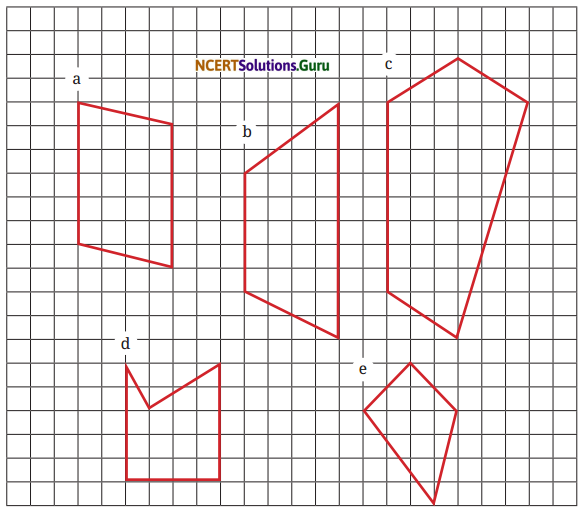
(b) Figure have 24 full rectangles, 2 half rectangles, 3 more than half and 3 less than half
∴ Area of figure = 24 + 1 + 2 × + 3 × 1 + 3 × 0
= 24 + 1 + 3 + 0
= 28 sq. units
(c) Figure have 36 full rectangles, 2 half rectangles, 9 more than half, and 10 less than half rectangles
∴ Area of figure = 36 × 1 + 2 × + 9 × 1 + 10 × 0
= 36 + 1 + 9 + 0
= 46 sq. units.
(d) Figure have 13 full rectangles, 1 half, 2 more than half and 2 less than half.
∴ Area of figure = 13 × 1 + 1 × + 2 × 1 + 2 × 0
= 13 + 0.5 + 2
= 15.5 sq. units
(e) Figure have 5 full rectangles, 5 half, 3 more than half and 4 less than half.
∴ Area of figure = 5 × 1 + 5 × + 3 × 1 + 4 × 0
= 5 + 2.5 + 3
= 10.5 sq. units
3 Area of A Triangle Figure it Out (Page 149)
Question 1
Solution:
Dimensions of rectangle 1: 5 m × 10m
Dimensions of rectangle 2:2m × 7m Area of rectangle 1 = 50 sq m Area of rectangle 2 = 14 sq m Now, area of rectangle = sum of areas of rectangle 1 and 2 = 50 sq m + 14 sq m = 64 sq m So possible dimensions of a rectangle with area 64 sq m are 1 m × 64 m; 2 m × 32 m; 4 m × 16 m; 8 m × 8 m, etc. |
Question 2
|
Question 3
|
Question 4
|
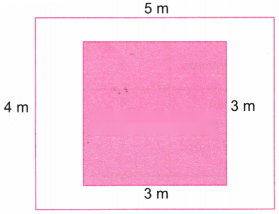
Now, also given that length of a flower bed = 2 m
and width of a flower bed = 1 m
The area of a flower bed = Length × Width
= 2 × 1
= 2 sq. m
Total area of 4 flower beds = 4 × 2
= 8 sq. m
The area available for laying down a lawn
= Area of the garden – Area of 4 flower beds
= 180 – 8
= 172 sq. m

Question 5
|
Question 6
|
Question 7
|
Question 8
|
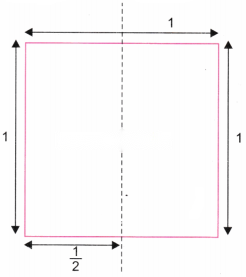
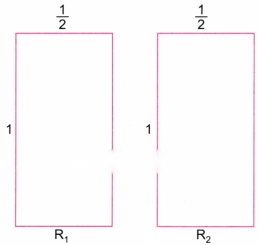
(b) Here perimeter of square = 4 units
and perimeters of both the rectangles = 3 + 3 = 6 units.
which is greater than 4 units.
Hence option (b) is not true.
(c) Here perimeters of both the rectangles = 6 units
and perimeter of square = 4 units × 1 = 4 × = 6 units.
The perimeters of both the rectangles added together are 1 times the perimeter of the square.
Hence, option (c) is true.
(d) Here, the area of the square = 4 units
and areas of both the rectangles = + = 1 unit.
The area of the square is four times the area of both rectangles.
Hence, option (d) is not true.
Intext Questions
Matha Pachchi! (Page No. 133)
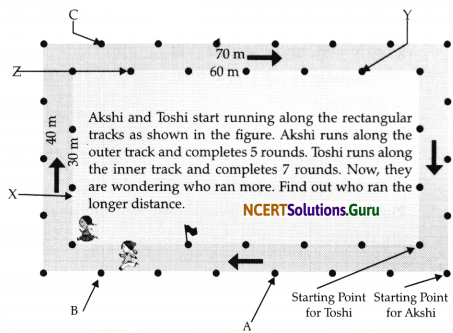
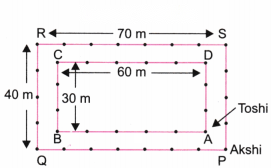
Akshi and Toshi start running along the rectangular tracks as shown in the figure. Akshi runs along the outer track and completes 5 rounds. Toshi runs along the inner track and completes 7 rounds. Now, they are wondering who ran more. Find out who ran the longer distance.
Solution:
Here, perimeter of rectangular track PQRS = 2 × (l + b)
= 2 × (70 + 40)
= 2 × 110
= 220 m
and perimeter of rectangular track ABCD = 2 × (60 + 30)
= 2 × 90
= 180 m
Deep Dive: (Page No. 134)
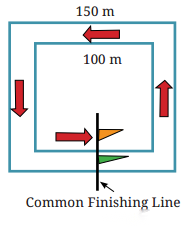
In races, usually, there is a common finish line for all the runners. Here are two square running tracks with an inner track of 100 m on each side and an outer track of 150 m on each side. The common finishing line for both runners is shown by the flags in the figure which are in the center of one of the sides of the tracks. If the total race is 350 m, then we have to find out where the starting positions of the two runners should be on these two tracks so that they both have a common finishing line after they run for 350 m. Mark the starting points of the runner on the inner track as ‘A ’ and the runner on the outer track as ‘B’.
Solution:
Inner Track (100 m per side)
Perimeter Calculation: The perimeter of the inner track is (4 times 100 = 400) meters.
Distance to Run: The runner on the inner track needs to run 350 meters.
Starting Position (A): Since the perimeter is 400 meters, the runner will start 50 meters before the common finish line (400 – 350 = 50 meters).
Outer Track (150 m per side)
Perimeter Calculation: The perimeter of the outer track is (4 times 150 = 600) meters.
Distance to Run: The runner on the outer track also needs to run 350 meters.
Starting Position (B): Since the perimeter is 600 meters, the runner will start 250 meters before the common finish line (600 – 350 = 250 meters).
Perimeter of a Regular Polygon (Page No. 135)
Find various objects from your surroundings that have regular shapes and find their perimeters. Also, generalize your understanding of the perimeter of other regular polygons.
Solution:
Some common objects with regular shapes and calculating their perimeters:
Here are a few examples:
1. Square Table:
Shape: Square
Side Length = 1 meter
Perimeter = 4 × 1 = 4 meters

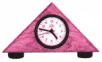
Equilateral Triangle Clock:
Shape: Equilateral Triangle
Side Length = 30 cm
Perimeter = 3 × 30 = 90 cm
3. Hexagonal Tile:
Shape: Regular Hexagon
Side Length = 10 cm
Perimeter = 6 × 10 = 60 cm
In general, the Perimeter of a Regular Polygon = (Number of sides) × (Side length of a polygon) units.

Split and Rejoin (Page No. 136)
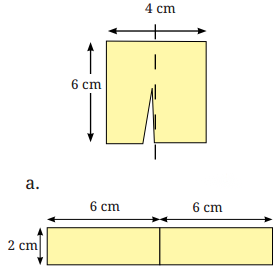
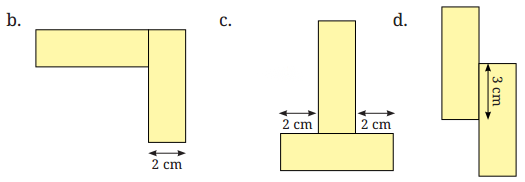
A rectangular paper chit of dimension 6 cm × 4 cm is cut as shown into two equal pieces. These two pieces are joined in different ways.
For example, the arrangement a. has a perimeter of 28 cm.
Find out the length of the boundary (i.e., the perimeter) of each of the other arrangements below.
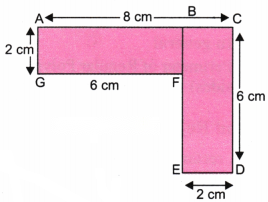
∴ Length of boundary = AB + BC + CD + DE + EF + FG + GA
= 6 + 2 + 6 + 2 + 4 + 6 + 2
= 28 cm
(c)
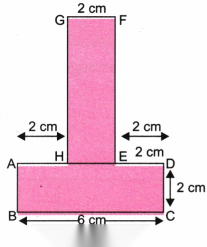
Total length of boundary = AB + BC + CD + DE +EF + FG + GH + HA
= 2 + 6 + 2 + 2 + 6 + 2 + 6 + 2
= 28 cm
(d)
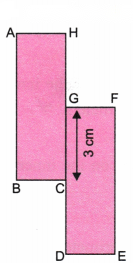
Total length of boundary = AB + BC + CD + DE + EF + FG + GH + HA
= 6 + 2 + 3 + 2 + 6 + 2 + 3 + 2
= 26 cm
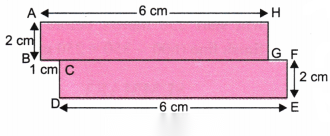
Arrange the two pieces to form a figure with a perimeter of 22 cm.
Solution:
Arranging the two pieces in such a way that they form a new shape with the desired perimeter:
Total length of boundary = AB + BC + CD + DE + EF + FG + GH + HA
= 2 + 1 + 2 + 6 + 2 + 1 + 2 + 6
= 22 cm
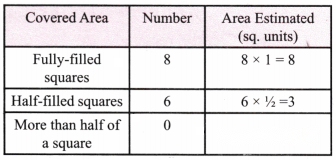
Find the area of the following figures. (Page No. 140)
Solution:
(i)
∴ Total area of the figure = 3 + 1 = 4 sq. units
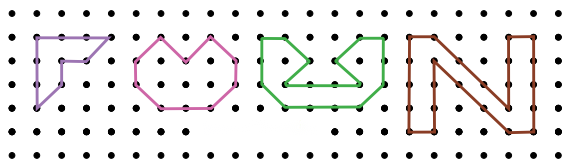
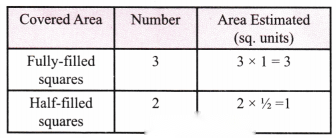
(ii)
∴ Total area of the figure = 6 + 3 = 9 sq. units
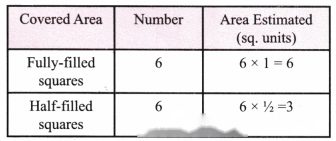
(iii)
∴ Total area of the figure = 7 + 3 = 10 sq. units
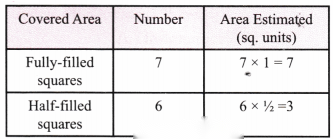
(iv)
∴ Total area of the figure = 8 + 3 = 11 sq. unit
Let’s Explore! (Page No. 141)
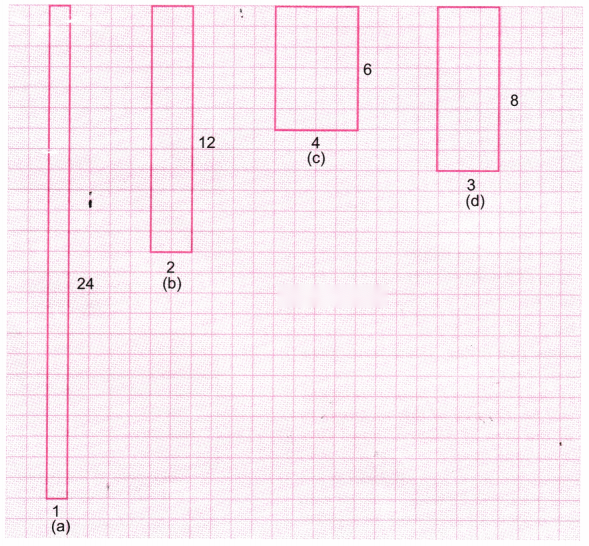
On a squared grid paper (1 square = 1 square unit), make as many rectangles as you can whose lengths and widths are a whole number of units such that the area of the rectangle is 12 square units.
(a) Which rectangle has the greatest perimeter?
(b) Which rectangle has the least perimeter?
(c) If you take a rectangle of area 32 sq cm, what will your answers be? Given any area, is it possible to predict the shape of the rectangle with the greatest perimeter as well as the least perimeter? Give examples and reasons for your answer.
Solution:
Perimeter of (a) = 2(1 + 24) = 2 × 25 = 50 units
Perimeter of (b) = 2(2 + 12) = 2 × 14 = 28 units
Perimeter of (c) = 2(4 + 6) = 2 × 10 = 20 units
Perimeter of (d) = 2(3 + 8) = 2 × 11 = 22 units
(a) Clearly rectangle (a) has the greatest perimeter.
(b) Obviously rectangle (c) has the least perimeter.
(c) Yes, it is possible to predict the shape of a rectangle with the greatest and least perimeter for a given area. Here’s how:
Greatest Perimeter: For a given area, the rectangle with the greatest perimeter will have one side as small as possible. This essentially means that the rectangle becomes very elongated.
For example, if the area is 24 square units, a rectangle with dimensions 1 unit by 24 units will have the greatest perimeter.
Example: Area = 24 square units
Dimensions = 1 unit by 24 units
Perimeter = 2(1 + 24) = 50 units
Least Perimeter: The rectangle with the least perimeter for a given area will be as close to a square as possible. This is because a square has the smallest perimeter for a given area among all rectangles.
Example: Area = 24 square units
Dimensions = 4 units by 6 units (since 4 × 6 = 24)
Perimeter = 2(4 + 6) = 20 units
Reasoning
Greatest Perimeter: When one side is minimized, the other side must be maximized to maintain the same area. This increases the sum of the sides, thus increasing the perimeter.
Least Perimeter: A square or a shape close to a square minimizes the sum of the sides for a given area, thus minimizing the perimeter.
Check! whether the two triangles overlap each other exactly. Do they have the same area?(Page No. 142)
Solution:
Two triangles overlap each other exactly, which means they are congruent. Congruent triangles have the same shape and size, which implies that they also have the same area.
Can you draw any inferences from this exercise? Please write it here.(Page No. 142)
Solution:
Congruence: The triangles are congruent, meaning all corresponding sides and angles are equal.
Area: Since the triangles are congruent, their areas are identical.
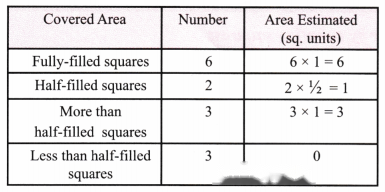
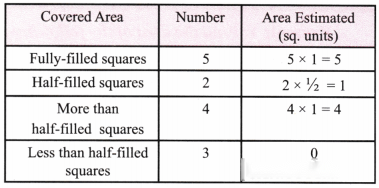
Use your understanding from previous grades to calculate the area of any closed figure using grid paper and-(Page No. 143)
1. Find the area of the blue triangle BAD.
2. Find the area of the red triangle ABE.
Solution:
1. Area of blue triangle BAD
∴ Total area of BAD = 6 + 1 + 3 = 10 sq. units
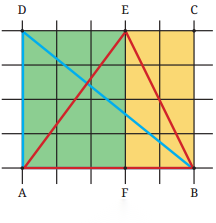
Area of red triangle ABE
∴ Total area of ABE = 5 + 1 + 4 = 10 sq. units
Area of rectangle ABCD = Number of fully tilled squares
= 20 × 1
= 20 sq. units
Making it ‘More’ or ‘Less’ (Page No. 145)
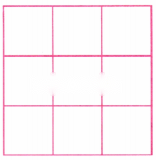
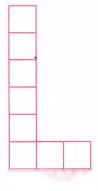
Using 9 unit squares, solve the following.
Question 1
Solution:
The smallest perimeter is achieved by forming a 3 × 3 square:
Perimeter = 3 + 3 + 3 + 3 = 12 units. |
Question 2
|

Question 3
|
Question 4
|

CBSE 2026-27 Board Exam Preparation & Practice Papers
Free Chapter Notes & Question Bank by BoardExams.in