NCERT Solutions • Class 6 Mathematics (Ganita Prakash) |
Get the simplifiedClass 6 Maths NCERT Solutionsof Ganita Prakash Chapter 7 Fractions textbook exercise questions with complete explanation.
Ganita Prakash Class 6 Maths Chapter 7 Solutions Fractions
1 Fractional Units and Equal Shares Figure it Out (Page No. 152 – 153)
Fill in the blanks with fractions.
Question 1
Solution:
|
Question 2
|
Question 3
|
As total quantity is 3 which is to be divided into four equal parts. So, the required fraction is .
Question 4
|
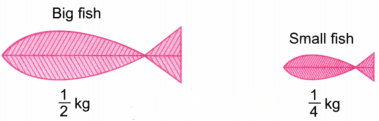
Question 5
|
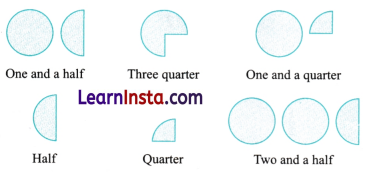
2 Fractional Units as Parts of a Whole Figure it Out (Page No. 155)
Question 1
|
The figure below shows different fractional units of a whole chikki. How much of a whole chikki is each piece?
Total no. of pieces formed of given size = 12
Required fraction =
(b)
Total no. of pieces formed of given size = 4
Required fraction =
(c)
Total no. of pieces formed of given size = 8
Required fraction =
(d)
Total no. of pieces formed of given size = 6
Required fraction =
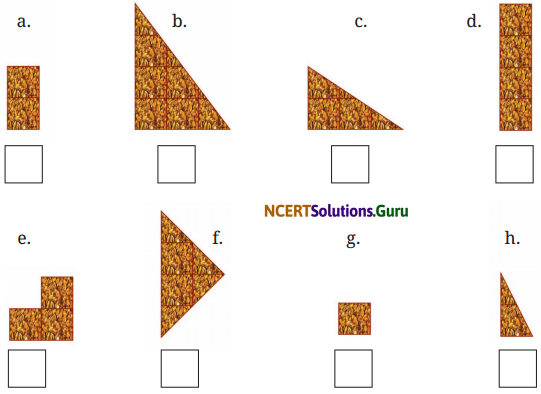
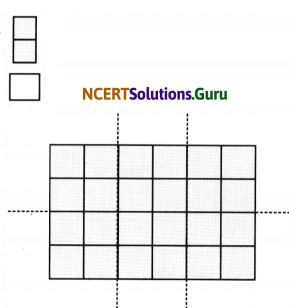
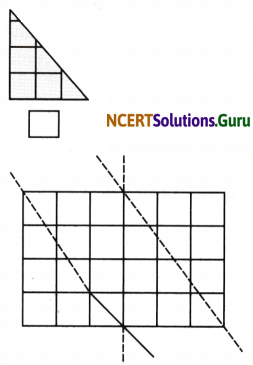
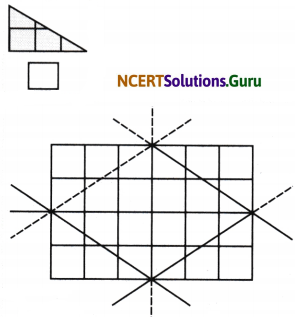
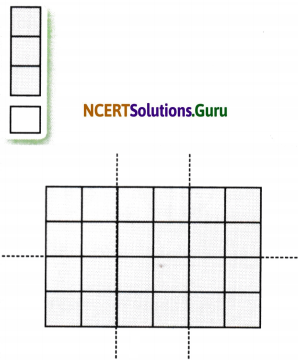
(e)
Total no. of pieces formed of given size = 8
Required fraction =
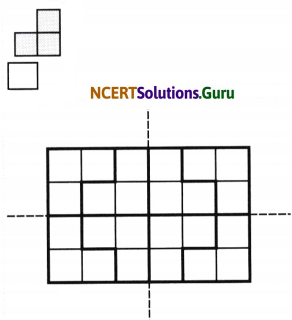
(f)
Total no. of pieces formed of given size = 8
Required fraction =
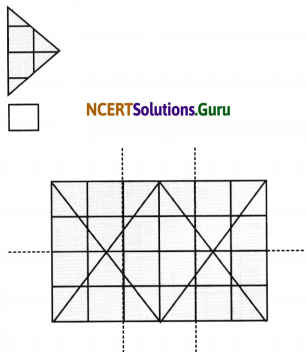

(g)
Total no. of pieces formed of given size = 24
Required fraction =
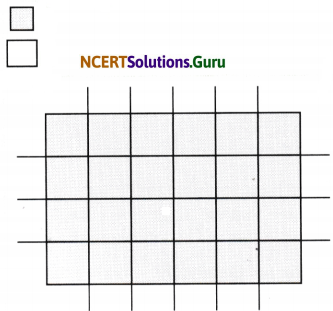
(h)
Total no. of pieces formed of given size = 12
Required fraction =
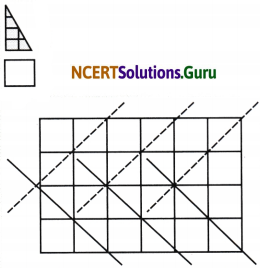
3 Measuring Using Fractional Units Figure it Out (Page No. 158)
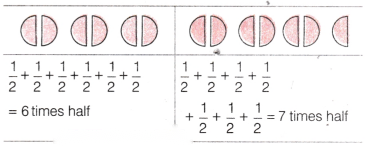
Question 1
Solution:
|
Question 2
|

Question 3
|
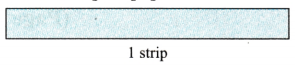
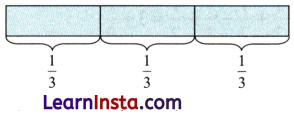
Question 4
|

(b) 9 times of a roti
Solution:
9 times of a roti
=


Question 5
|
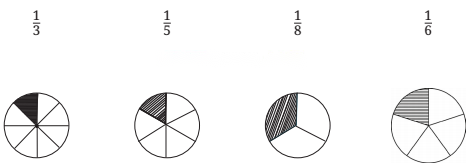
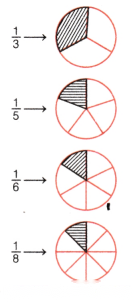
4 Marking Fraction Lengths on the Number Line Figure it Out (Page No. 160)
Question 1
Solution:
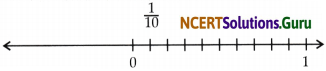
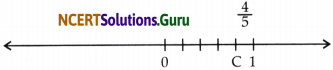
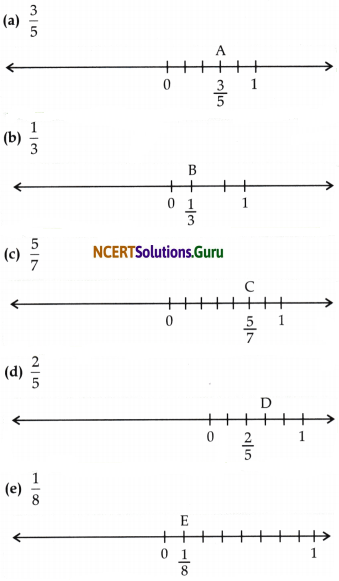
Divide the unit into 10 equal parts and point A represents . Divide a unit into 10 equal parts and point B represents . Divide a unit into 5 equal parts and point C represents . |

Question 2
|
Question 3
|
Question 4
|

Question 5
|


Intext Questions
Question 1
|

Question 2
|

Question 3
|

5 Mixed Fractions Figure it Out (Page No. 162)
Question 1
Solution:
So, there are 3 whole units in . |
Question 2
|
5 Mixed Fractions Figure it Out (Page No. 162)
Question 1
Solution:
(a) 2
(b) 2 (c) 2 |
Question 2
|
Question 3
|
(b)
Solution:
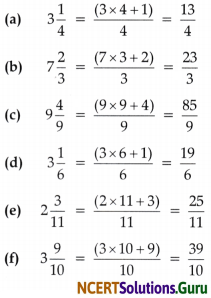
= 1
(c)
Solution:
= 1
(d)
Solution:
= 5
(e)
Solution:
= 1
(f)
Solution:
= 3
5 Mixed Fractions Figure it Out (Page No. 163)
Question 1
Solution:
|
6 Equivalent Fractions Figure it Out 7.7 Simplest form of a Fraction Figure it Out (Page No. 165)
Question 1
Solution:
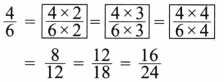
Here, simplest form of [HCF of 3 and 6 is 3]
and simplest form of is [HCF of 4 and 8 is 4] and simplest form of is [HCF of 5 and 10 is 5] Hence, are equivalent fractions. |
Question 2
|
Question 3
|
Intext Questions
Question 1
|
Question 2
|
Question 3
|
Question 4
|
7 Simplest form of a Fraction Figure it Out (Page No. 166)
Question 1
Solution:
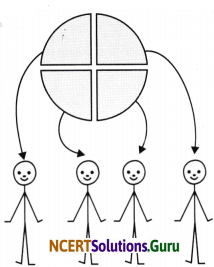
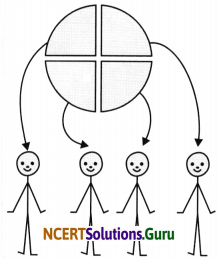
One roti is shared as shown in the figure below:
The four shares must be equal to each other! Similar distribution will be done for the second and third roti also. So, each child will get a piece of roti. The division fact is 3 ÷ 4 = The addition fact is 3 = The multiplication fact is 3 = 4 × |

Question 2
|
Question 3
|
Anil was in a group where 2 cakes were divided equally among 5 children. How much cake would Anil get?
Solution:
Anil would get part of the cake.
7 Simplest form of a Fraction Figure it Out (Page No. 168 – 169)
Question 1
Solution:
(a) Here, the amount of juice each friend gets when 5 glasses are shared among 4 friends =
Now to determine how many glasses of juice would be needed to give each of the 8 friends the same amount = 8 × = 10 glasses So, 10 glasses of juice shared equally among 8 friends is the same as 5 glasses of juice shared equally among 4 friends. ∴ |
(b) Here 4 kg of potatoes divided equally in 3 bags then amount of potatoes per bag = kg per bag
Let x is the number of bags for 12 kg of potatoes, where each bag has the same amount of potatoes then
kg per bag
⇒ 12 × 3 = 4 × x
⇒ 36 = 4x
⇒ x =
⇒ x = 9
∴
(c) Dividing 7 rotis among 4 children gives 7 each child = of a roti. We can find an
equivalent fraction by multiplying both the numerator and the denominator by the same number. For example, multiplying both by 2.
So, 7 rotis divided among 5 children is the same as 14 rotis divided among 10 children
∴
Intext Questions
Question 1
|
(b) and
Solution:
Given fractions are and
Here, the denominators are 3 and 6.
And least common multiple of 3 and 6 is 6.
Now for multiply both the numerator and the denominator by 2.
already have a denominator 6.
Hence, the equivalent fractions with the same denominator are:
and
(c) and
Solution:
Given fractions are and
Here, the denominators are 4 and 5.
And least common multiple of 4 and 5 is 20.
Now for multiply both the numerator and the denominator by 5.
And for multiply both the numerator and the denominator by 4, we get
So, the equivalent fractions with the same denominator are:
and
(d) and
Solution:
Given fractions are and
Here, the denominators are 7 and 5.
And least common multiple of 7 and 5 is 35.
Now for multiply both the numerator and the denominator by 5.
And for multiply both the numerator and the denominator by 7, we get
So, the equivalent fractions with the same denominator are:
and
(e) and
Solution:
Given fractions are and
Here, the denominators are 4 and 2.
And least common multiple of 4 and 2 is 4.
Now for multiply both the numerator and the denominator by 2.
and already have a denominator 4
So, the equivalent fractions with the same denominator are:
and
(f) and
Solution:
Given fractions are and and
Here, the denominators are 10 and 9.
And least common multiple of 10 and 9 is 90.
Now for multiply both the numerator and the denominator by 9.
And for 2 multiply both the numerator and the denominator by 10, we get
So, the equivalent fractions with the same denominator are:’
and
(g) and
Solution:
Given fractions are and
Here, the denominators are 3 and 4.
And least common multiple of 3 and 4 is 12.
Now for multiply both the numerator and the denominator by 4.
And for multiply both the numerator and the denominator by 3, we get
So, the equivalent fractions with the same denominator are:
and
(h) and
Solution:
Given fractions are and
Here, the denominators are 6 and 9.
And least common multiple of 6 and 9 is 18.
Now for multiply both the numerator and the denominator by 3.
And for multiply both the numerator and the denominator by 2, we get
So, the equivalent fractions with the same denominator are:
and
7 Simplest form of a Fraction Figure it Out (Page No. 173)
Question 1
Solution:
|
(b)
Solution:
(c)
Solution:
(d)
Solution:
8 Comparing Fractions Figure it Out (Page No. 174)
Question 1
Solution:
|
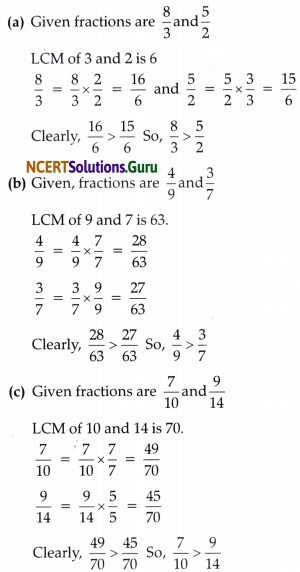
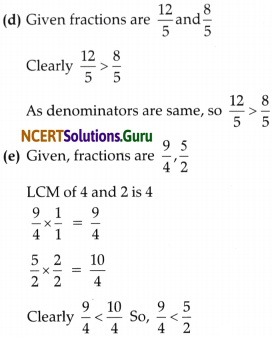
Question 2
|
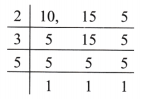
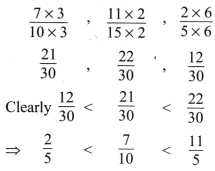
(b)
Solution:
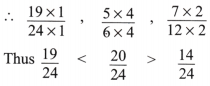
The given fractions are
Here LCM of 24, 6, 12 is 24.
On arranging in ascending Order, we get
⇒
Question 3
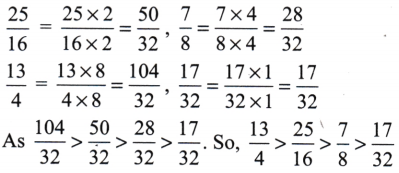
|
(b)
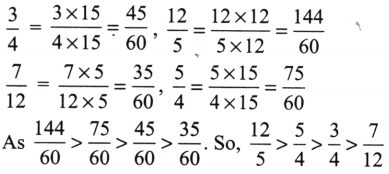
Solution:
9 Relation to Number Sequences Figure it Out (Page No. 179)
Question 1
Solution:
= =1 |

(b)
Solution:
=
=
= 1
(c)
Solution:
= 1
(d)
Solution:
=
(e)
Solution:
=
= 1
(f)
Solution:
= 1
(g)
Solution:
= 1
(h)
Solution:
=
(i)
Solution:
= 5
(j)
Solution:
= 2
(k)
Solution:
= 1
(l)
Solution:
= 1

(m)
Solution:
=
Question 2
|
Rahim mixes liters of yellow paint with liters of blue paint to make green paint What is the volume of green paint he has made?
Solution:
Quantity of yellow paint added = litres
Quantity of blue paint added = litres
Total quantity of green paint made = +
LCM of 3 and 4 is 12.
So, the total quantity of paint made is liters.

Question 3
|
9 Relation to Number Sequences Figure it Out (Page No. 181)
Question 1
Solution:
Given
As fractional unit is same i.e., we shall simply subtract numerators keeping fractional unit as Then = (representing in simplest form) |
Question 2
|
Question 3
|
9 Relation to Number Sequences Figure it Out (Page No. 182)
Question 1
Solution:
Given
Fractional unit for both fractions is then = |
(b)
Solution:
Given
Here LCM of 5 and 15 is 15. Fractional unit for both fractions should be
then
=
=
=
(c)
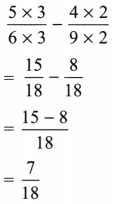
Solution:
Given
Hence LCM of 6 and 9 is 18. Fractional unit for both fractions should be then
(d)
Solution:
Given
Here LCM of 3 and 2 is 6. Fractional unit for both fractions should be
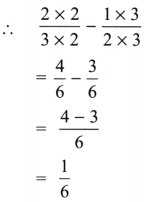
Question 2
|
(b) from
Solution:
The denominators of the given fractions are 3 and 5.
The LCM of 3 and 5 is 15.
Then,
Therefore,
(c) from
Solution:
The denominators are same.
Therefore,
Question 3
|
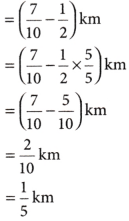
(b) Jeevika takes minutes to take a complete round of the park and her friend Namit takes minutes to do the same. Who takes less time and by how much?
Solution:
Time taken by Jeevika = minutes
and time taken by Narnit = minutes
Now, and
Clearly, >
∴ Jeevika takes less ti me by minutes
= minutes
= minutes.
CBSE 2026-27 Board Exam Preparation & Practice Papers
Free Chapter Notes & Question Bank by BoardExams.in