BoardExams.in
Class 6social scienceCBSE 2026-27

NCERT Solutions for Class 6 social science Chapter 2: Oceans and Continents Class 6

18 Solved Questions & Exercises7 min estimated readingUpdated 2026-09-16
Top Sponsor / Ad Space

CBSE 2026-27 Board Exam Preparation & Practice Papers

Free Chapter Notes & Question Bank by BoardExams.in

NCERT Solutions • Class 6 Social Science (Exploring Society)
Chapter 2: Oceans and Continents Class 6
Latest Rationalised Syllabus (NEP 2026-27)

Chapter-wiseExploring Society India and Beyond Class 6 Solutionsand Class 6 Social Science SST Chapter 2 Oceans and Continents Question Answer NCERT Solutions are useful for focused study.

Oceans and Continents NCERT Class 6th SST Chapter 2 Question Answer

Oceans and Continents Class 6 Questions and Answers

The Big Questions (Page 27)

Question 1


What are oceans and continents? What are their names and their distribution?
Answer:
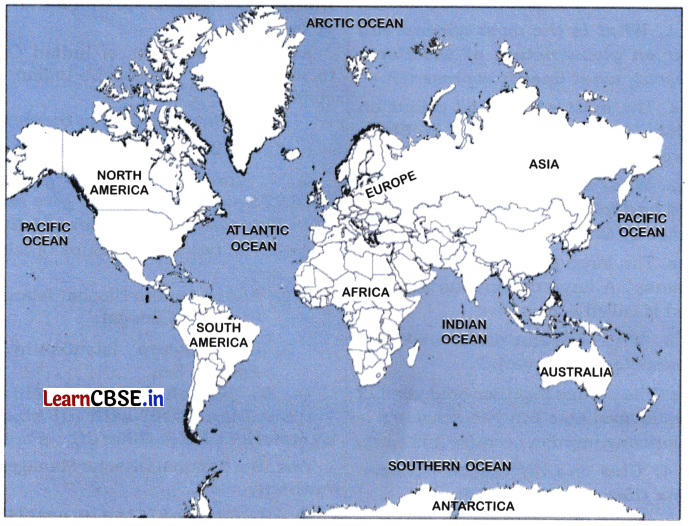
The Earth’s surface is divided into oceans and continents of which almost three-fourths is covered with water and 1 /4th with land. 97% of this water is in Oceans. That is why, Earth is called the ‘Blue planet’.

Question 1 (1)

The largest water bodies, we see on the globe are called ‘Oceans’. They are all interconnected and level of water remains same everywhere (MSL i.e. Mean Sea Level).

2. A large continuous expanse of land is called a continent.

3. There are five major Oceans of the world from the largest to the smallest they are :
(a) The Pacific Ocean.
(b) The Atlantic Ocean.
(c) The Indian Ocean.
(d) The Southern Ocean.
(e) The Arctic Ocean.

4. The Pacific Ocean is the largest and spreads on about 30% area of the earth.
5. It. is circular in shape. The world’s deepest part of the earth — Mariana Trench lies under the Pacific Ocean.
6. It is bounded by Asia and Australia on one side and North the South America on the other.

7. The Atlantic Ocean is the second largest and is ‘S’ shaped.

The Indian Ocean is the third largest and only Ocean named after a country (India/Bharat). It is shaped almost like a triangular.

The southern Ocean is the Ocean around the continent of Antarctica.

The Arctic Ocean is smallest of all the Oceans and is located within the Arctic Circle and surrounds the North Pole.

There are seven continents. In order of size they are: Asia, Africa, North America, South America, Antarctica, Europe, and Australia.

Europe: It is joined to the continent of Asia. In the north it is bound by the Arctic Ocean, west by the Atlantic Ocean and south by the Mediterranean Sea.
Australia: It is the smallest of the seven continents. It is bound on all sides by seas and oceans and thus also known as island continent.

Question 2


In what ways do oceans and continents impact life on Earth, including human life?

Solution:
Oceans and continents impact life on Earth including human life in a number of ways.

Like Oceans continents too impact life on Earth. Continents (7) are home to various landforms— mountains, plains, plateaus, deserts. They support varied plant and animal life giving rise to many interesting eco systems in nature.

Let’s Explore

Question 1


What are the circular lines in each map called? And do you know what the lines radiating out of the two poles are called? (Hint: you studied them in the previous chapter, but here they are presented differently.) (Page 29)
Answer:
The circular lines in each map are called – parallels of latitudes. Lines radiating from the two poles are called – Meridians of longitudes.

Question 2


Which hemisphere holds more water?
Answer:
The Southern Hemisphere has more water than the Northern Hemisphere.

Question 3


What do you think could be the approximate proportion of water to land in the Northern Hemisphere? And in the Southern Hemisphere? Discuss in groups. (Page 29)
Answer:

Question 4


Are all the oceans connected with one another, or are there separations between them? (Page 29)
Answer:
Yes all the five Oceans are interconnected.

Question 5


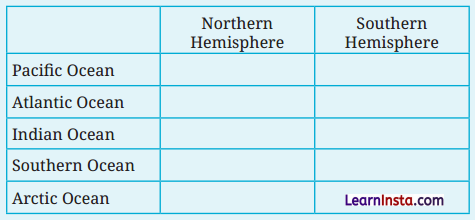
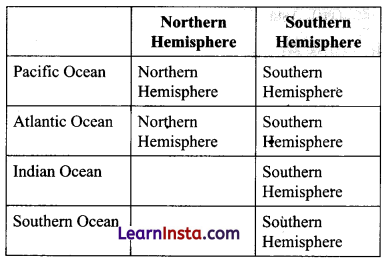
Locate the five oceans and, in the table below, mark the hemisphere or hemispheres they belong to. (Page 32)

Answer:

Oceans and Continents Class 6 Diagram 1

Oceans and Continents Class 6 Diagram 2

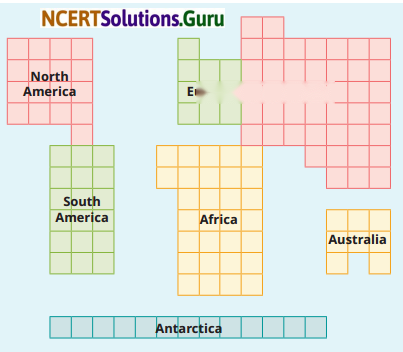
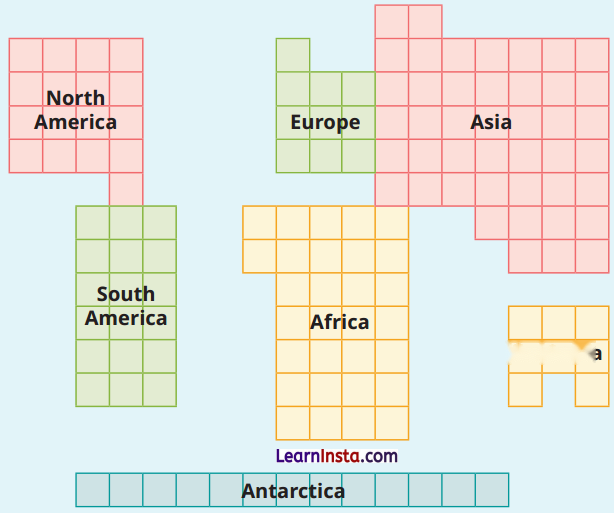
Obserye the below image and answer the following questions: (Page 36)
Oceans and Continents Class 6 Diagram 3

Question 6


Counting the numbers of squares, name the largest continent and the smallest.

Answer:
Asia is the largest continent.
Australia is the smallest continent.

Oceans and Continents Class 6 Diagram 4

Question 7


Which one is larger-North America or South America, Africa or North America, Antarctica or Australia?
Answer:
South America is larger than North America, Africa is larger than North America and Antarctica is larger than Australia.

Question 8


Re-colour the diagram by having a single colour for Europe and Asia and rename the result as ‘Eurasia’. Compare its size with South America’s. (Page 36)
Answer:
Eurasia (54 squares) is three times the size of South America (18 squares).

Question 9


Write down the list of continents from the smallest to the largest.
Answer:
Here is a list of continents from the smallest to the largest:

Think About it

Question 1


If there is such abundance of water on the planet, why is there so much talk of ‘water scarcity’ or a ‘water crisis’? (Page 31)
Answer:
The oceans together hold 3/4th of the water available on our planet.

Question 2


What ways of saving water are you aware of? Which ones have you seen practised at home, at your school, and in your village, town or city? (Page 31)
Answer:
Water being a precious gift of nature, and an essential and scarce resource needs to be used judiciously.
Home :

Or

School:

Or

Village/Town/City.

Questions, Activities and Projects (Pages 39-40)

Question 1


Explain the following terms:
(a) Continent
(b) Ocean
(c) Island
Answer:
(a) Continent: A large continuous expanse of land is called a continent. Example: Asia, North America.
(b) Oceans: Vast water bodies on the surface of the earth are called oceans. Example: Pacific Ocean, Indian Ocean.
(c) Island: Some smaller places of land surrounded by water on all sides are called Islands. Example: Lakshadweep Islands, Andaman and Nicobar Islands.

Question 2


Let us draw – Without looking at the maps in this chapter, draw the continents free hand on a sheet of paper and colour them. Then compare your drawing with the map of oceans and continents in the chapter.
Answer:
Do it yourself.

Question 3


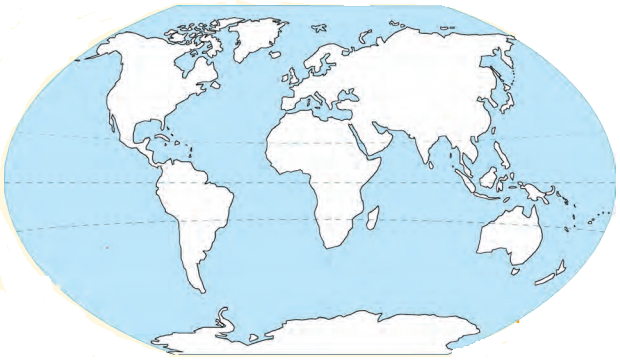
Let us. do – On the outline map of the world given below, label all the continents and oceans.

Answer:

Oceans and Continents Class 6 Diagram 5

Oceans and Continents Class 6 Diagram 6

Question 4


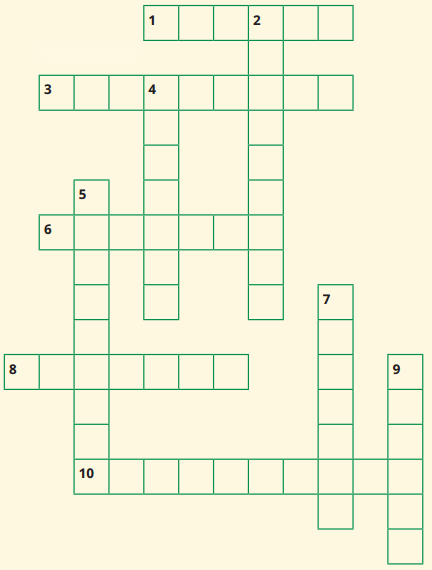
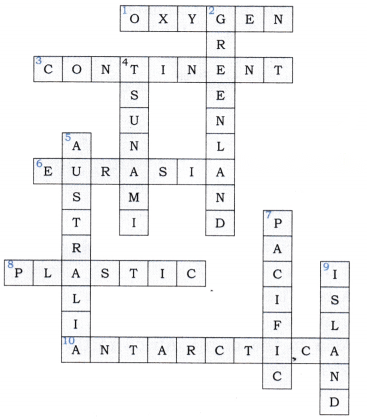
Solve the crossword.

Across
1. Abundantly produced by the oceans
3. A large expanse of landmass
6. A large continent of which India is a part
8. A major source of pollution of the oceans
10. The coldest continent

Oceans and Continents Class 6 Diagram 7

Down
2. The largest island on Earth
4. A huge destructive wave from the ocean
5. The smallest continent
7. The largest body of water on the Earth
8. A landmass (but not a continent) surrounded by the sea or ocean
Answer:
Oceans and Continents Class 6 Diagram 8

Class 6 Social Science Question Answer

In-Article Ad Slot

CBSE 2026-27 Board Exam Preparation & Practice Papers

Free Chapter Notes & Question Bank by BoardExams.in