BoardExams.in
Class 6social scienceCBSE 2026-27

NCERT Solutions for Class 6 social science Chapter 3: Landforms and Life Class 6

26 Solved Questions & Exercises9 min estimated readingUpdated 2026-09-16
Top Sponsor / Ad Space

CBSE 2026-27 Board Exam Preparation & Practice Papers

Free Chapter Notes & Question Bank by BoardExams.in

NCERT Solutions • Class 6 Social Science (Exploring Society)
Chapter 3: Landforms and Life Class 6
Latest Rationalised Syllabus (NEP 2026-27)

Chapter-wiseExploring Society India and Beyond Class 6 Solutionsand Class 6 Social Science SST Chapter 3 Landforms and Life Question Answer NCERT Solutions are useful for focused study.

Landforms and Life NCERT Class 6th SST Chapter 3 Question Answer

Landforms and Life Class 6 Questions and Answers

The Big Questions (Page 41)

Question 1


What are the major types of landforms and their significance to life and culture?
Answer:
The major types of landforms and their significance to life and culture are as follows:
Mountains: They are large landforms that rise prominently above their surroundings. Their significance is that it affects the climate and weather pattern, provide freshwater from rivers and streams originating in mountains. It is considered sacred in various cultures. It is home to unique flora and fauna.

Plains: They are large areas of flat or gently rolling land. It is ideal for farming due to fertile soil, easy to build infrastructure, leading to dense human settlements. Plain areas are cultural and economic hubs due to ease of transportanion and trade.

Plateaus: They are elevated flatlands that rise sharply above the surrounding area. They are rich in minerals and often sites for mining. They are suitable for certain types of agriculture and livestock grazing. Plateaus are home to unique ecosystems and sometimes isolated communities with distinct cultures.

Hills: They are elevated landforms that are smaller than mountains. They are used for terraced farming, provide scenic views and are popular for tourism. Many historical sites and ancient structures are located on hills.

Deserts: They are arid regions with little precipitation and sparse vegetation. In deserts, there is extreme temperatures and harsh living conditions. But it is rich in minerals like oil and natural gas and home to unique cultures and traditions adapted to the harsh environment.

Valleys: They are low areas between hills or mountains, often with a river running through them. Valleys are fertile land due to river deposits, ideal for farming, provide natural protection and resources for communities. Often the cradle of ancient civilizations due to the availability of water and fertile soil.

Question 2


What are the challenges and opportunities of life associated with each landform?
Answer:
The challenges and opportunities of life associated with each landform are:
1. Mountains: Mountain areas are more susceptible to natural hazards and disasters, such as avalanches, landslides, cloudburst and flash floods. Mountains are very steep and rugged, which can impact daily life agriculture also.
Opportunities: Mountains are the store house of natural beauty with fertile soil.

Question 1 (2)

Plateaus: One of the main challenges of plateau is the outgoing erosion of their surface. This erosion can lead to a patchy landscape which can hinder the development of agriculture and the construction of infrastructure like roads.

3. Plains: The plains are ideal for growing crops of all kinds. Agriculture is a major economic occupation in the landforms. Plains also support a variety of flora and fauna.

Let’s Explore

Question 1


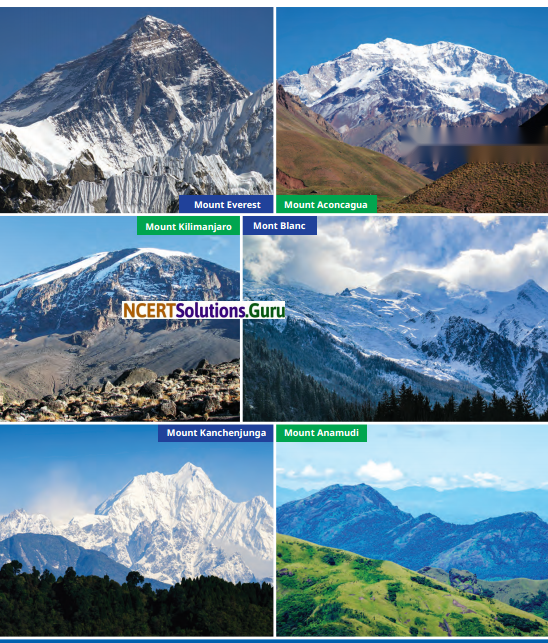
These images depict a few challenges that people living in the mountains may face. Discuss them in groups in the class and write one paragraph on each. Also discuss, why, despite many such challenges, people still choose to live in the mountains.

Solution:
At higher altitudes air becomes thinner and the pressure of oxygen decreases. Thus, breathing becomes difficult on mountains. On the mountains, weather is very harsh like colds are a bit more colder and there are more chances of wildfire.

Landforms and Life Class 6 Diagram 1

In many places, people depend on mountains for water, either coming from melting snow or ice or from mountain springs which feed the rivers. But, surviving in harsh climate of mountain can be tough and it can be hard to grow enough food there. Still people live there, as it is their habitat and they are used to live in such weather from generations.

Question 2


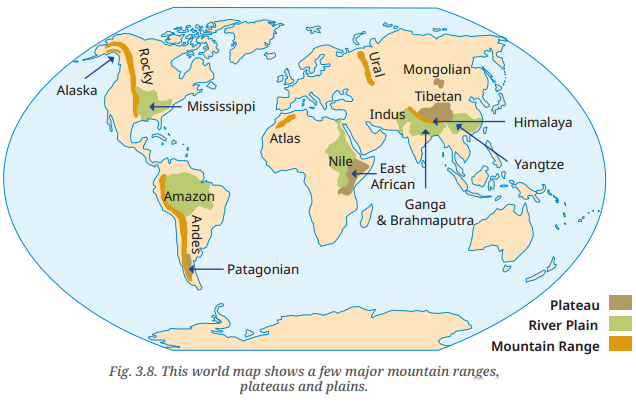
Use the colour code in the map given below to add a landform to each name. For instance, ‘Tibetan Plateau’, ‘Rocky range’, ‘Nile plain’. (You do not have to remember the names in this map.)


Answer:
Do it yourself

Landforms and Life Class 6 Diagram 2

Question 3


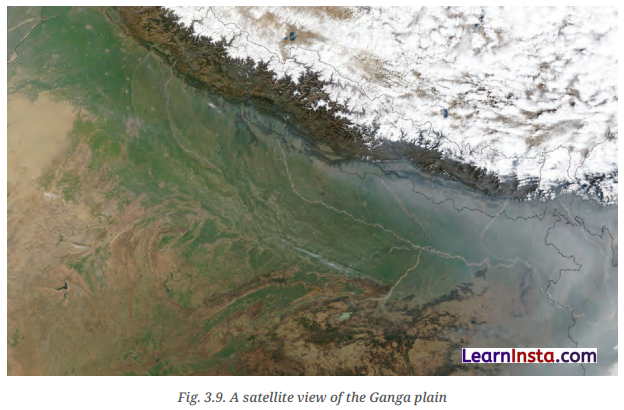
The picture (Page 49) is taken from a satellite. It captures a portion of north India from a high altitude. Observe and discuss the image as a class activity.

Landforms and Life Class 6 Diagram 3

(i) Which colour is the Ganga plain?
Answer:
Green

(ii).What does the white expanse represent?
Answer:
Snow

(iii) What does the brown expanse at the bottom left of the image represent?
Answer:
Himalayas

Question 4


Can you give examples of river sources or confluences from your region that are regarded sacred by any community? (Page 55)
Answer:
Rivers are the main source of fresh water. I am impressed by that region where I am living. River Ganga passes from nearby place. Cool air blows in the morning birds are chirping. The water is flowing with great speed with full enthusiasm. Fisherman catch hold of the fishes. Children are enjoy near the bank of the river. They have their Pet animals also with them.

Question 5


Visit a nearby river and observe all activities there, whether economic or cultural. Note them down and discuss with your classmates.
Answer:
Students do this activity themselves.

Question 6


Name some popular tourist destinations in India and identify the category of landform they are associated with.
Answer:
Some popular tourist destinations in India and their landforms are as follows
(a) Leh-cold desert
(b) Mussoorie-mountains
(c) Thar safari-hot desert
(d) Kochi-sea coast
(e) Varanasi-plains

Think About It

Question 1


What is Snow? (Page 43)
Answer:
Snow is the precipitation of water in a solid state.

Question 2


What are the ‘western to the eastern oceans’? Can you locate them as well as the ‘Lord of mountains’ on Fig. 5.2? (Page 46)
Answer:
1. Oceans:

Question 2 (2)

Mountains:

Question 3


Why is Ganga mentioned? Hint: There could be several reasons. (Page 46)

Solution:
Ganga is the sacred river of Hindus and personified as the Goddess Ganga. She is worshipped by,Hindus who believe that bathing in the river causes the remission of sins.

Questions, Activities and Projects (Page 58)

Question 1


In what type of landform is your town/village/city located? Which features mentioned in this chapter do you see around you?
Answer:
I am living in a town where the landform is quite plain. We can do agriculture work on this land as the soil is quite fertile. Black soil is found on the very large scale. So we can do the cultivation of cotton on a very large scale. Farmers are growing crops on large scale as they have their own lands near by this river.

Question 2


Let us go back to our initial trip from Chhota Nagpur to Prayagraj and Almora. Describe the three landforms you came across on the way.
Answer:
The Chhota Nagpur Plateau is a plateau in eastern India which covers much of Jharkhand state, adjacent parts of Chhattisgarh, Odisha, West Bengal and Bihar.
Prayagraj is one of most ancient & sacred town of India based on the river Ganges plains. It is known for confluence of three rivers.
Almora lies is in the beautiful Kumaon mountain range.

Question 3


List a few famous pilgrimage spots in India along with the land- forms in which they are found.
Answer:
Some of the eminent pilgrimage destination in India include ancient and revered destinations such as Rishikesh, Mathura, Haridwar, Dwarka, Varanasi, Tirupati, Amritsar, Nashik, Kanyakumari, Kolhapur, Rameshwaram, Shirdi, Puri.
Landform of Haridwar: It is covered by Mountains, hills, rivers. Tall trees are the real beauty. Weather is quite chilled. Holy river is flowing their i.e. River Ganga. People use to take holy dip in this river to get rid of their sins.
Rishikesh: It is also covered by mountains, hills. All around the area green is there. It is a place which is always overcrowded by the people. The major Landforms are mountains. They are very tall and weather is quite chilled in winter and moderate in summer.

Question 4


State whether True or false:
1. The Himalayas are young mountains with rounded tops.
Answer:
False

Question 3 (2)

Plateaus usually rise sharply at least on one side.

Solution:
False
Question 4 (3)

Mountains and hills belong to the same type of landform.

Solution:
True
Question 5 (4)

Mountains, plateaus and rivers in India have the same types of flora and fauna.

Solution:
False
Question 6 (5)

Ganga is a tributary to the Yamuna.

Solution:
False
Question 7 (6)

Deserts have unique flora and fauna.

Solution:
True
Question 8 (7)

Melting snow feeds rivers.

Solution:
True
Question 9 (8)

Sediments from rivers deposited in the plains makes the land fertile.

Solution:
True
Question 10 (9)

All deserts are hot.

Solution:
False
Question 5


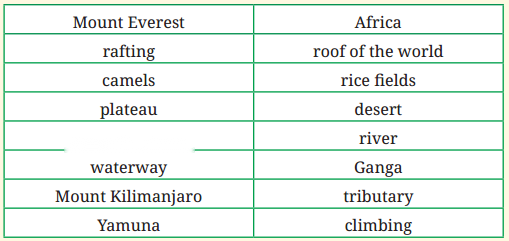
Match words in pairs:

Answer:

Landforms and Life Class 6 Diagram 4

(a) Mount Everest

climbing

(b) rafting

river

(c) camels

desert

(d) plateau

roof of the world

(e) Gangetic plains

Ganga

(f) waterway

rice fields

(g) Mount Kilimanjaro

Africa

(h) Yamuna

Tributary

Class 6 Social Science Question Answer

In-Article Ad Slot

CBSE 2026-27 Board Exam Preparation & Practice Papers

Free Chapter Notes & Question Bank by BoardExams.in