BoardExams.in
Class 6social scienceCBSE 2026-27

NCERT Solutions for Class 6 social science Chapter 6: The Beginnings of Indian Civilisation Class 6

13 Solved Questions & Exercises5 min estimated readingUpdated 2026-09-16
Top Sponsor / Ad Space

CBSE 2026-27 Board Exam Preparation & Practice Papers

Free Chapter Notes & Question Bank by BoardExams.in

NCERT Solutions • Class 6 Social Science (Exploring Society)
Chapter 6: The Beginnings of Indian Civilisation Class 6
Latest Rationalised Syllabus (NEP 2026-27)

Chapter-wiseExploring Society India and Beyond Class 6 Solutionsand Class 6 Social Science SST Chapter 6 The Beginnings of Indian Civilisation Question Answer NCERT Solutions are useful for focused study.

The Beginnings of Indian Civilisation NCERT Class 6th SST Chapter 6 Question Answer

The Beginnings of Indian Civilisation Class 6 Questions and Answers

The Big Questions (Page 85)

Question 1


What is a civilisation?
Answer:
A Civilisation is a complex society with the following key features:

Question 2


What was the earliest civilisation of the Indian Subcontinent?
Answer:
The earliest known Civilisation of the Indian subcontinent is the Indus Valley Civilisation, also known as the Harappan Civilisation.

Question 3


What were its major achievements?
Answer:
The Harappan Civilisation achieved great things for its time, here are some of their major achievements:

Let’s Explore

Question 1


For each characteristic in the list (on page 86), can you make a list of professions or occupations that might exist in such a society? (Page 87)
Answer:
A list of professions or occupations that might exist in a civilisation with each of the characteristics are as follows:
Government and Administration:
Rulers/Monarchs: Oversee the governance of the society.
Officials/Bureaucrats: Manage various administrative tasks and public services.
Judges: Resolve legal disputes and administer justice.
Tax Collectors: Gather revenue to fund the government and public projects.
City Managers: Coordinate and supervise the operations of urban areas.

Urbanism (Town Planning and City Management):

Crafts and Production:

Trade (internal and external):

Writing and Record-Keeping:

Cultural Ideas (art, architecture, literature, etc.):

Productive ‘Agriculture:

Question 2


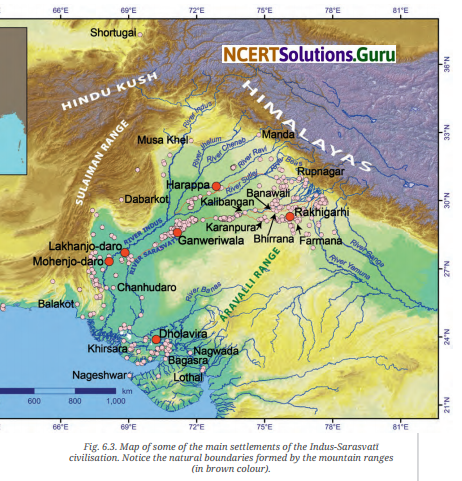
Some of the important cities of this civilisation are marked in the map (Fig. 6.3). As a class activity, can you try to match these cities with the modern states or regions in the table on the next page?

The Beginnings of Indian Civilisation Class 6 Diagram 1

Harappan city

Modern state/region

Dholavira
Harappa
Kalibangan
Mohenjo-daro
Rakhigarhi

Punjab
Gujarat
Sindh
Haryana
Rajasthan

Solution:

The correct pairs are:
(i) Dholavira – Gujarat
(ii) Harappa – Punjab
(iii) Kalibangan – Rajasthan
(iv) Mohenjo-daro – Sindh
(v) Rakhigarhi – Haryana

Questions, Activities and Projects (Page 104)

Question 1


Why does the civilisation studied in this chapter have several names? Discuss their significance.
Answer:
The Civilisation has several names such as Harappan, Indus, or Indus- Sarasvatl Civilisation. This is because it was discovered in the region along the Indus River and its tributaries, and the city of Harappa, so with these names, it connects to all these points.

Question 2


Write a brief report (150 to 200 words) summing up some of the achievements of the Indus-Sarasvati civilisation.
Answer:
The Indus-Sarasvati Civilisation, one of the earliest known in the history of mankind, came up with some remarkable achievements such as-

Question 3


Imagine you have to travel from the city of Harappa to Kaliban- gan. What are your different options? Can you make a rough estimation of the amount of time each option might take?
Answer:
Traveling from Harappa to Kalibangan in ancient times would primarily involve land routes. Utilising the Indus River for the initial part of the journey would be the most efficient as this water route is not only convenient but also safe to start with. Further, followed by overland travel using horse, bullock carts or on foot. The total distance of approximately 200 kilometers and hence this might take few days, depending on the conditions and speed of travel.

Question 4


Let us imagine a Harappan man or woman being transported to an average kitchen in today’s India. What are the four or five biggest surprises awaiting them?
Answer:
We can imagine how it can be a revelation for a Harappan man or women being transported to an average kitchen in today’s India. There will be many surprises for him such as

Question 5


Looking at all the pictures in this chapter, make a list of the ornaments / gestures / objects that still feel familiar in our 21st century.
Answer:
The ornaments, gestures, and objects from the Harappan civilisation that still feel familiar in the 21st century are below listed:

Question 6


What mindset does the system of reservoirs at Dholavira reflect?
Answer:
The system of reservoirs at Dholavira reflects the following mindset:

Question 7


In Mohenjo-daro, about 700 wells built with bricks have been counted. They seem to have been regularly maintained and used for several centuries. Discuss the implications.
Answer:
The use of about 700 wells built with brick have several implications. Some of them are as follows

Question 8


It is often said that the Harappans had a high civic sense. Discuss the significance of this statement. Do you agree with it? Compare with citizens in a large city of India today.
Answer:
The statement that the Harappans had a high civic sense is absolutely correct. The evidence from Harappan sites like Harappa, Mohenjo-daro, and Dholavira supports this statement. The excavations clearly suggest that the cities were well-planned, there were advanced drainage systems, all houses had private bathrooms and standardised construction techniques were put in place.

The Harappans demonstrated a strong commitment to cleanliness, hygiene, and public welfare, as seen in the uniformly laid out streets, public baths, and extensive water management systems like wells and reservoirs. These features highlight that the Harappans prioritsed public health and efficient urban living.

Class 6 Social Science Question Answer

In-Article Ad Slot

CBSE 2026-27 Board Exam Preparation & Practice Papers

Free Chapter Notes & Question Bank by BoardExams.in