NCERT Solutions • Class 7 Science (Curiosity) |
Chapter-wiseChapter 7 Heat Transfer in Nature Class 7 Questions and Answers are useful for focused study.
Class 7 Science Chapter 7 Heat Transfer in Nature Question Answer
Science Class 7 Chapter 7 Question Answer Heat Transfer in Nature
Heat Transfer in Nature Class 7 Question Answer (InText)
Question 1
|
Question 2
|
Material | Good or Poor conductor of heat |
Material | Good or Poor conductor of heat |
Steel | Good Conductor |
Wood | Poor Conductor |
Plastic | Poor Conductor |
Bakelite | Poor Conductor |
Aluminium | Good Conductor |
Question 3
|
Question 4
|
Question 5
|
Question 6
|
NCERT Class 7 Science Chapter 7 Question Answer Heat Transfer in Nature (Exercise)
Let Us Enhance Our Learning
Question 1
|
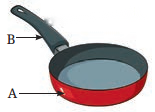
(a) Both A and B are good conductors of heat
(b) Both A and B are poor conductors of heat
(c) A is a good conductor and B is a poor conductor of heat
(d) A is a poor conductor and B is a good conductor of heat
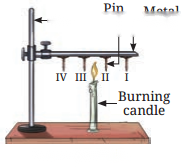
(ii) Pins are stuck to a metal strip with wax and a burning candle is kept below the rod, as shown in Fig. 7.15. Which of the
following will happen?
(a) All the pins will fall almost at the same time
(b) Pins I and II will fall earlier than pins III and IV
(c) Pins I and II will fall later than pins III and IV
(d) Pins II and III will fall almost at the same time
Fig. Transfer set-up
(iii) A smoke detector is a device that detects smoke and sounds an alarm. Suppose you are fitting a smoke detector in your room. The most suitable place for this device will be:
(a) Near the floor
(b) In the middle of a wall
(c) On the ceiling
(d) Anywhere in the room
Answer:
(i) (c) A is a good conductor and B is a poor conductor of heat
(ii) (d) Pins II and III will fall almost at the same time
(iii) (c) On the ceiling
Question 2
|
Question 3
|
(ii) False, heat transfer takes place in solids through conduction. Heat transfer through convection takes place by the actual movement of particles.
Answer:
True
(iii) Areas with clay materials allow more seepage of water than those with sandy materials.
Answer:
False, areas with particles of gravel allow more seepage of water as the space or pores between the particles of gravel is more as compared to sandy materials.
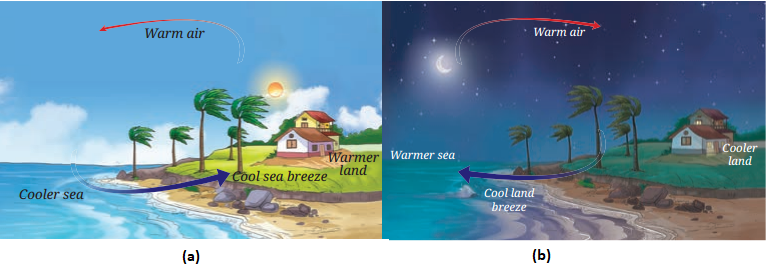
(iv) The movement of cooler air from land to sea is called land breeze.
Answer:
True
Question 4
|
Question 5
|
Question 6
|
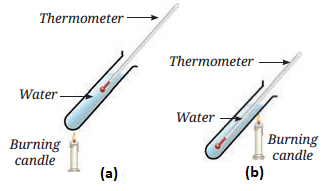
In Fig. (b), the thermometer is placed at the bottom of the test tube, but the candle flame heats the side of the test tube. The side heating may not be as effective in transferring heat to the bottom where the thermometer is placed. Therefore, the thermometer in Fig. (a) will record a higher temperature.
Question 7
|
Question 8
|
Question 9
|
Question 10
|
Class 7 Heat Transfer in Nature Question Answer (Activities)
Activity 7.1: Let Us Experiment (Page 90)
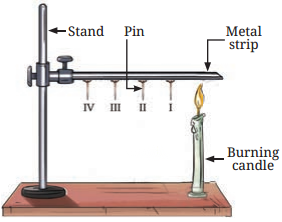
Table 7.1: Falling of pins
Pin falling first | Reasons for what you observed | |
Prediction | Observation | |
Pin I | Pin I | Pin I fell first as it was closest to the burning candle, causing the wax to melt quickly |
Pin II | Pin II | As heat transferred from Pin I to Pin II. As expected, Pin II fell after Pin I, due to heat conduction. |
Pin III | Pin III | Pin III fell after Pin II, also due to heat conduction. |
Pin IV | Pin IV | At last Pin IV fell as it was farthest from the burning candle. So it took the longest time to heat up and melt the wax. |
Conclusion: Transfer of heat takes place from the hot end of the strip to the colder end.
Activity 7.2: Let Us Investigate (Page 92)
Fig. (a): Initial set-up (b): Hot air rising up
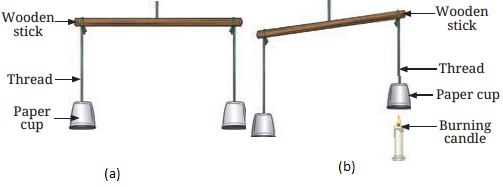
Observations about the cups | Probable reasons for the observation |
The cup under which the burning candle is placed rises up. | It would have rised because the air near the candle and inside the cup heats up, expands and rises. |
Activity 7.3: Let Us Find Out (Pages 93-94)
Fig. (a): Initial set-up for demonstration (b): Demonstration of convection in heated water
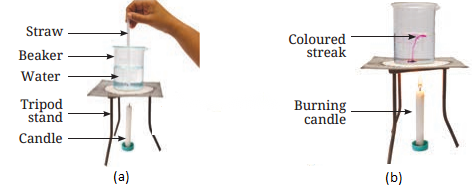
Observation: When heat is supplied, a streak of colour starts moving up and then coming down from the sides.
Conclusion:
• The streak of coloured water moves upward in the middle and then comes down along the sides. This happens because when the water at the bottom of the beaker gets heated, it expands, becomes lighter, and rises. Cooler water from the sides then moves down to take its place. This process of convection continues until the entire volume of the water becomes heated. Because of this convection, we see the movement of coloured streaks in the beaker.
• Water, like air, is heated through the process of convection.
Activity 7.4: Let Us Investigate (Pages 94-95)Fig. Measurement of the temperature of soil and water
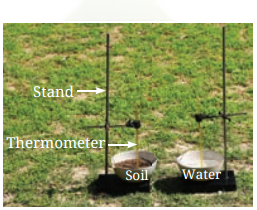
Observation: When the temperature of the soil and water is measured by placing them in sunlight then the rise in the temperature of soil was more as compared to water after a particular period of time. Conclusion: Soil heats up faster than water.
Activity 7.5: Let Us Investigate (Page 99)
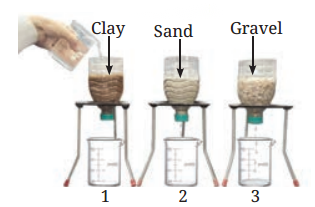
Fig. An activity to compare the flow of water through clay, sand and gravel
Table 7.5: Seepage of water
Bottles filled with | Prediction | Observation |
Seepage of water (very slow/slow/ fast) | Seepage of water (very slow/slow/fast) | |
Bottle 1 (Clay) | slow | very slow |
Bottle 2 (Sand) | fast | slow |
Bottle 3 (Gravel) | very slow | fast |
Conclusion: The spaces or pores between the particles of gravel are much larger than those in sand and clay. This allows water to pass through the gravel much faster. Clay has the smallest particles and smallest pores, so water seeps through it the slowest. Sand falls in between. Thus, the flow of water depends on the size of the soil particles and the space between them. Gravel, with its large gaps, allows the fastest seepage of water among the three materials.
CBSE 2026-27 Board Exam Preparation & Practice Papers
Free Chapter Notes & Question Bank by BoardExams.in