NCERT Solutions • Class 7 Social Science (Exploring Society) |
Students can keepExploring Society India and Beyond Class 7 Solutionsand Class 7 Social Science SST Chapter 4 New Beginnings Cities and States Question Answer NCERT Solutions handy for quick reference during exams.
Class 7 Social Science Chapter 4 Question Answer New Beginnings Cities and States
NCERT Class 7 Social Science Chapter 4 New Beginnings Cities and States Questions and Answers Solutions
New Beginnings Cities and States Class 7 Question Answer (In-Text)
The Big Questions? (page 67)
Question 1
|
Question 2
|
Question 3
|
Let’s Explore
Question 1
|
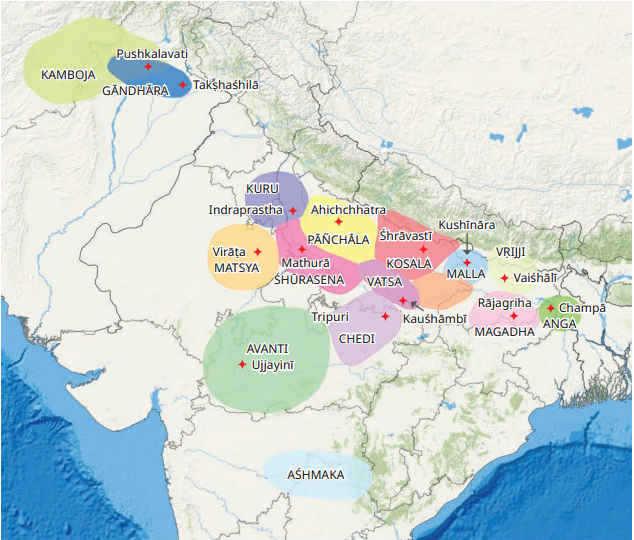
Question 2
|
Question 3
|
First Urbanisation | Second Urbanisation | |
Ganga plains | ||
Monasteries | ||
Literature | ||
Trade | ||
Warfare | ||
Copper/bronze | ||
Iron |
First Urbanisation | Second Urbanisation | |
Ganga plains | No | Yes |
Monasteries | No | Yes |
Literature | No | Yes |
Trade | Yes | Yes |
Warfare | Yes | Yes |
Copper/bronze | Yes | Yes |
Iron | No | Yes |
Question 4
|
Question 5
|
III. Think About It
Inequalities within society can exist in many forms. Have you encountered any incident where you or anyone you know might have been made to feel different from others? Do you think equality is desirable in a society? If so, why? Have you come across people or initiatives that lessened inequalities? (page 78)
Answer:
Yes, inequalities within society can exist in many forms such as economic status, caste, gender, religion, language, or even appearance. Many people have experienced or witnessed such inequalities in different ways.
Here’s a sample response:
Yes, I have seen incidents where people were made to feel different because of their background or appearance. For example, a friend of mine who came from a small town was sometimes laughed at in school for having a different accent. This made him feel left out and uncomfortable. I believe equality is very desirable in a society, because everyone deserves to be treated with respect and dignity, no matter where they come from or what they look like. When people are treated equally, they feel valued and are more confident to contribute to society. I have also seen some positive examples, like schools offering scholarships to students from disadvantaged backgrounds, or community groups helping people get access to education and healthcare. These initiatives help reduce the gap between rich and poor and create a fairer, more inclusive society.
Class 7 SST Chapter 4 New Beginnings Cities and States Question Answer (Exercise)
Question 1
|
(i) Fortifying the capital and frontier towns:
Then: Protection through physical defense structures and strategic planning.
Now: We focus on national security, border management, smart cities, and disaster preparedness. Cybersecurity is the modern frontier. The core idea security for stability remains unchanged.
(ii) The land must sustain both the population and outsiders in times of calamity:
Then: Preparedness for famine, war, or displacement. Now: We talk about food security, refugee support systems, emergency relief funds, and disaster management authorities. The value of resilience still stands strong.
(iii) Natural wealth cultivable land, forests, pastures, mines, water, etc.:
Then: A kingdom’s strength came from self-sufficiency and natural resources.
Now: Nations still invest heavily in agriculture, mining, renewable energy, and biodiversity. Climate change and sustainability efforts echo Kautilya’s foresight about not depending solely on rain.
(iv) Good roads and waterways:
Then: Infrastructure as a backbone for trade and connectivity.
Now: The same transportation networks, logistics systems, digital infrastructure. Connectivity equals growth.
(v) A productive economy with diverse commodities: Then: Economic diversification to ensure stability and growth.
Now: Economists still preach this. A country with multiple strong sectors—agriculture, industry, services, tech is more stable and resilient to global shocks.
It is not different today. The core principles that Kautilya laid out are still very much in use just adapted to our times with modem tools and language. What stands out is how timeless his ideas are. His emphasis on balance between economy, environment, defense, and social welfare is a model for sustainable development even now.
Question 2
|
Question 3
|
(ii) Archaeological Sources: Excavations at ancient sites reveal much about the culture. For example mins of cities like Rajgir, Ujjain, Taxila give us clues about urban planning, defense (forts), religious buildings, and daily life. Artifacts like pottery, tools, ornaments show levels of craftsmanship, trade links, and domestic life. These sources bring physical evidence of the existence, lifestyle, and technological level of the Mahajanapadas.
(iii) Numismatic Sources (Coins): Coins issued by different Mahajanapadas, especially Punch-marked coins often bear information about the rulers of that period. They reveal economic practices, trade, state authority, and interactions with other regions.
By using all these sources together, we can gather much clearer, multi-dimensional picture of the Mahajanapadas how they functioned, interacted, and shaped the early history of the Indian subcontinent.
Question 4
|
(i) Stronger Tools and Weapons: Iron tools like ploughs, axes, and sickles were stronger and more durable than their earlier stone or copper counterparts. This led to more efficient agriculture, forestry, and construction. Greater agricultural productivity could support larger populations, which is essential for towns and cities to emerge.
(ii) Craft and Trade Specialization: Iron tools boosted various crafts like carpentry, masonry, and metalwork. As agriculture stabilized, more people could take up non-farming occupations (blacksmiths, traders, builders). These craftspeople and traders often lived in urban centers, where their goods could be exchanged or sold.
(iii) Growth of Trade and Infrastructure: Iron was also used to make transport tools (wheels, carts), helping in trade and connectivity. Urban centers often developed along trade routes, benefiting from increased mobility and commerce. Cities grew as commercial and administrative hubs.
CBSE 2026-27 Board Exam Preparation & Practice Papers
Free Chapter Notes & Question Bank by BoardExams.in