BoardExams.in
Class 7social scienceCBSE 2026-27

NCERT Solutions for Class 7 social science Chapter 5: The Rise of Empires Class 7

20 Solved Questions & Exercises12 min estimated readingUpdated 2026-09-16
Top Sponsor / Ad Space

CBSE 2026-27 Board Exam Preparation & Practice Papers

Free Chapter Notes & Question Bank by BoardExams.in

NCERT Solutions • Class 7 Social Science (Exploring Society)
Chapter 5: The Rise of Empires Class 7
Latest Rationalised Syllabus (NEP 2026-27)

Students can keepExploring Society India and Beyond Class 7 Solutionsand Class 7 Social Science SST Chapter 5 The Rise of Empires Question Answer NCERT Solutions handy for quick reference during exams.

Class 7 Social Science Chapter 5 Question Answer The Rise of Empires

NCERT Class 7 Social Science Chapter 5 The Rise of Empires Questions and Answers Solutions

The Rise of Empires Class 7 Question Answer (In-Text)

The Big Questions? (Page 83)

Question 1


What is an empire?
Answer:
An empire is a large territory made up of many smaller kingdoms or regions that are ruled by a single powerful ruler known as an emperor. The emperor maintains control through a strong army, centralized administration, infrastructure, and economic management. An empire often expands through conquest and unites diverse cultures under one rule.

Question 2


How did empires rise and shape Indian civilisation?
Answer:
Empires in India rose by uniting smaller kingdoms, often through warfare, strategic alliances, and strong leadership. For example, the Magadha kingdom used its fertile land, iron resources, and powerful armies to conquer neighboring regions. The rise of empires like that of the Nandas and later the Mauryas brought about administrative systems, organized trade, cultural development, and improved infrastructure. These empires laid the foundation for a unified Indian civilisation with shared economic systems, languages, and cultural practices.

Question 3


What factors facilitated the transition from kingdoms to empires?
Answer:
Several factors facilitated the transition from kingdoms to empires in ancient India:

Question 4


What was life like from the 6th to the 2nd century BCE?
Answer:
Fife during the 6th to the 2nd century BCE was dynamic and evolving. Cities like Pataliputra were bustling centers of administration, trade, and culture. People were involved in various occupations—blacksmiths made weapons, traders dealt in goods from across India and abroad, and artisans contributed to art and architecture. Trade guilds (shrenis) managed commercial activities. Public entertainments, marketplaces, religious activities, and construction projects like caves for monks were common. This period also saw the rise of great empires, which brought political stability, economic growth, and cultural development.

Let’s Explore

Question 1


Empires extended over vast areas and had diverse
people with differing languages, customs and cultures. How do you think the emperors made sure that they lived in harmony? (Page 89)
Answer:
To ensure harmony among diverse people within their empires, emperors likely used several strategies:

Question 2


Looking at the many challenges involved in managing an empire, why should a king be so keen to expand his kingdom into an empire and become an emperor?
• An ambition to ‘rule the entire word’, a metaphor for controlling large territories and ensuring that they would be remembered for posterity;
• A wish to bring large areas under control and gain access to their resources to build economic and military strength;
• A desire for great wealth for himself and for the empire.
Answer:

Question 3


Warfare apart, what other methods do you think the rulers might have used to expand their empires? Pen your ideas and share them with your class. (Page 91)
Answer:
Apart from warfare, rulers may have used several peaceful and strategic methods to expand their empires, such as:

Question 4


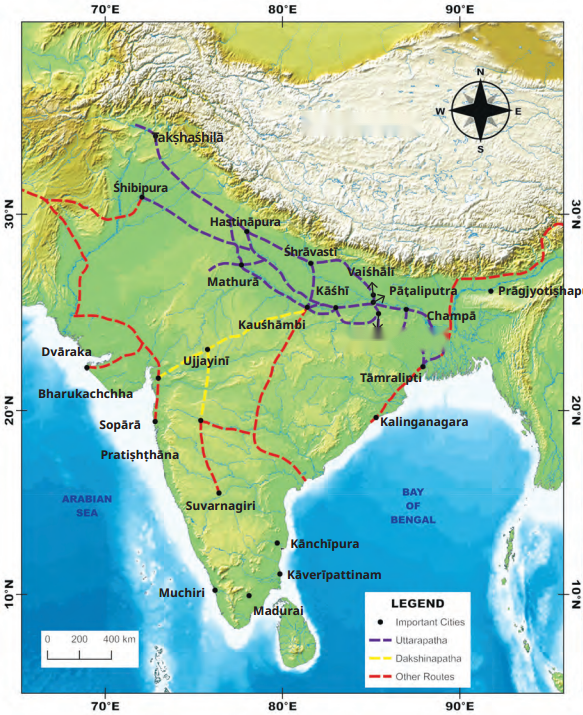
Observe the map of the trade routes (given below). Identify geographical features that helped the traders travel across the subcontinent. (Page 93)

Answer:
The following geographical lcaturcs helped traders travel across the subcontinent:

The Rise of Empires Class 7 Diagram 1

Question 5


What modes of transport on those roads do you think were available at the time? (Page 93)
Answer:
During ancient times, the following modes of transport were likely used by traders:

Question 6


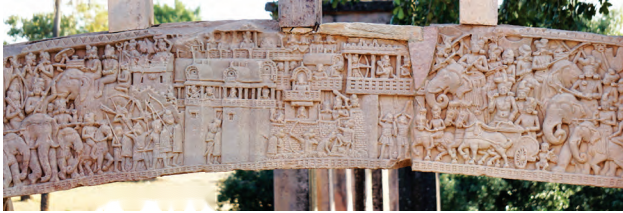
Take a close look at the panel given below. (Page 94)

(i) How many types of weapons can you identify? What different uses of iron can you make out?
Answers.
Types of weapons identified are swords, spears, arrows and shields. The different uses of iron are:

The Rise of Empires Class 7 Diagram 2

(ii) In the left part of the panel, a parasol (chhattra) is kept over the casket containing the Buddha’s relics. Why do you think this was done?
Answer:
The parasol or chhattra is a traditional symbol of royalty and spiritual protection in ancient Indian art and culture. Placing it over the Buddha’s relics signifies reverence and honor, marking the relics as sacred and spiritually powerful. It also reflects the
Buddha’s elevated status as a revered teacher and enlightened being, often shown with royal symbols in Buddhist iconography.

Question 7


When, after the battle, Alexander asked Porus how he wished to be treated, Porus answered, “Like a King.” Alexander then left Porus at the head of his kingdom, as satrap. With the help of your teachers, find more details on the battle between Porus and Alexander. Enact a play of this battle scene using your imagination in addition to what you have discovered. (Page 97)
Answer:
Summary for research and play enactment:

Key elements for the play:

This event is remembered as a classic example of valour and respect between rivals in history.

Question 8


Kautilya says, “A king shall increase his power by promoting the welfare of his people, for power comes from the countryside which is the source of all economic activity. [The king] shall show special favours to those in the countryside who do things which benefit the people, such as building embankments or road bridges, beautifying villages, or helping to protect them.” (Page 103)
Answer:
Do it yourself.

Question 9


Why do you think it was important to take special care of the countryside? (Hint: Think back to what you have learnt at the beginning of this chapter) (Page 103)
Answer:
Do it yourself.

Question 10


Ashoka details instructions on the conduct of his officials and mentions ways to ensure that they practiced fairness in one of his edicts. Read the translation below and share your thoughts on whether those ways would have been successful in helping manage his empire and how.

“By order of the Beloved of the Gods-the officers and city magistrates [… ] are to be instructed thus: […] You are in charge of many thousands of living beings. You should gain the affection of men. All men are my children, and just as I desire for my children that they should obtain welfare and happiness both in this world and the next, the same do I desire for all men. [ … ] You should strive to practice impartiality. [ … ] The root of all this is to be even-tempered and not rash in your work. [ … ] This inscription has been engraved here in order that the city magistrates should at all times see to it that men are never imprisoned or tortured without good reason. [ … ] And for this purpose, I shall send out on tour every five years, an officer who is not severe or harsh; who, having investigated this matter, shall see that they carry out my instructions. ” (Page 107)
Answer:
Ashoka’s edict shows that he wanted his officials to rule with kindness, fairness, and responsibility. He considered all people as his own children and wished for their well-being, both in this life and the next. By giving clear instructions, he told his officers to be fair, avoid being harsh or angry, and never imprison or torture anyone without a good reason. He also planned regular checks every five years by sending special officers to make sure his rules were being followed. This helped control misuse of power and encouraged justice. These steps likely helped Ashoka manage his vast empire better by building trust between the people and the government, and by promoting peace and fairness in society.

Question 11


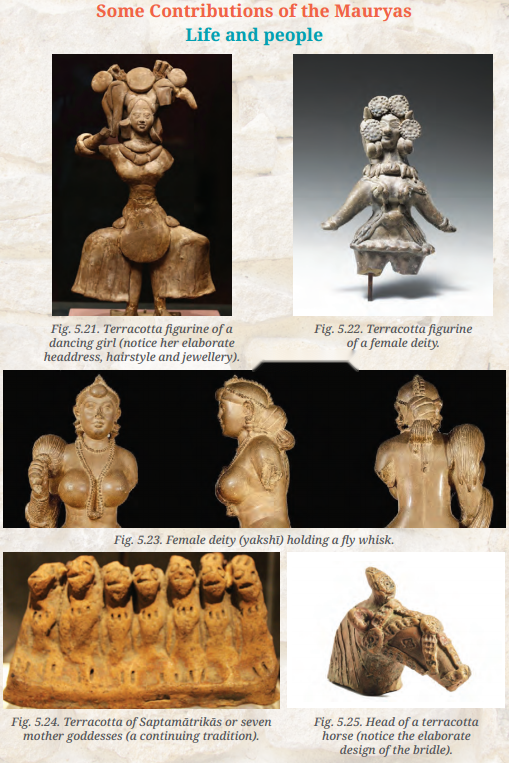
Wear the hat of a historian. Look carefully at the artefacts presented on the spread as shown below. What conclusions can you draw about people and life during the Mauryan era?

Answer:
By studying these artefacts, we can learn a lot about the people and culture of the Mauryan period:
(i) Terracotta figurine of a dancing girl: This suggests that music and dance were important forms of entertainment and cultural expression. People appreciated the arts and may have enjoyed performances in their daily lives.

The Rise of Empires Class 7 Diagram 3

(ii) Terracotta figurine of a female deity: It shows that religion and worship of goddesses were a part of everyday life. People believed in divine powers and created figures for prayer or rituals.

(iii) Yakshi holding a fly whisk: Yakshis were nature spirits linked to fertility and prosperity. This shows that people respected nature and worshipped symbols of growth and abundance.

(iv) Terracotta of saptamatrikas (seven mother goddesses): The worship of mother goddesses shows the importance of feminine power and protection. People may have prayed to these goddesses for safety, health, and blessings.

(v) Head of a terracotta horse (with bridle design): This shows that horses were used for travel or possibly in the military. The careful design of the bridle means they paid attention to animal care and craftsmanship. The Mauryan people were religious, artistic, and skilled in craftwork. They valued nature, worship, beauty, and performance, and lived in a society that encouraged creativity and spiritual life.

Question 12


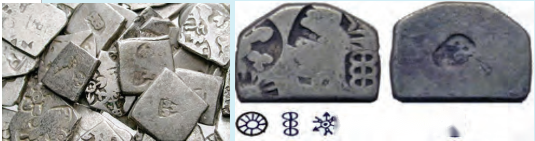
Notice the different symbols on the coins. Can you guess what any of the symbols in the coins below might mean? (Page 112)

The Rise of Empires Class 7 Diagram 4

Question 1 (1)

Tree or Pillar Symbols: Some of the coins feature symbols like trees or pillars. These may be representations of royal authority or Buddhist symbolism, reflecting the influence of Ashoka’s reign, during which Buddhism was promoted. The pillar symbol could represent Ashoka’s pillar edicts, which carried messages about his policies and governance. The tree symbol might reflect the Bodhi tree, under which the Buddha attained enlightenment, symbolizing peace and wisdom.

2. Wheel or Chakra: A wheel, or chakra, is often seen on these coins and may represent the Dharma Chakra (the Wheel of Dharma). This symbol is directly associated with Buddhism and the teachings of the Buddha, which Ashoka promoted throughout his empire. It symbolizes the cycle of life, truth, and the path to enlightenment.

3. Animal Symbols (Elephant, Bull, Horse, Lion ):Various animals like the elephant, bull, horse, and lion are depicted on the coins. These animals may represent strength, royal power, and divinity:

4. Geometric Patterns: Some coins might feature geometric designs like squares, circles, or waves. These designs could be abstract representations of the cosmic order or other spiritual concepts that were important during the time, such as the balance of nature or unity of the universe.

5. Symbols of Prosperity and Wealth: The coins themselves were used for trade and commerce, so symbols related to wealth or abundance, such as a grain symbol (possibly representing food security and agricultural prosperity), might have been used to denote the economy and the state’s support of trade.

Think About It

Question 1


Why do you think Alexander wanted to rule over the entire world? What would he have gained from it? (Page 97)

Solution:
Alexander wanted to rule over the entire world because of:
Question 2


Kautilya says, “A king shall increase his power by promoting the welfare of his people, for power comes from the countryside which is the source of all economic activity. [The king] shall show special favours to those in the countryside who do things which benefit the people, such as building embankments or road bridges, beautifying villages, or helping to protect them.” Why do you think it was important to take special care of the countryside? (Hint: Think back to what you have leamt at the beginning of this chapter. (Page 103)
Answer:
It was important to take special care of the countryside because it was the source of all economic activity. Kautilya believed that power comes from the countryside, which is primarily responsible for agricultural production, raw materials, and overall economic stability. By ensuring the well-being of rural areas, the king would strengthen the economic foundation of his kingdom and, in turn, increase his power.

Question 3


Ashoka, in his edicts, tells the story of the Kalinga war. He could have chosen not to mention it and maintain his image as a peaceful, benevolent king for future generations. Why do you think he admitted to this destructive war? (Page 104)
Answer:
Ashoka admitted to the Kalinga war in his edicts because he wanted people to leam from his mistakes. After seeing the pain and suffering caused by the war, he felt deep regret. Instead of hiding it, he chose to tell the truth to show how the war changed him. This honesty helped him teach the value of peace and kindness. By sharing this story, Ashoka showed that even a powerful king can change and choose non-violence, which made his message more powerful and real for future generations.

In-Article Ad Slot

CBSE 2026-27 Board Exam Preparation & Practice Papers

Free Chapter Notes & Question Bank by BoardExams.in