NCERT Solutions • Class 7 Social Science (Exploring Society) |
Students can keepExploring Society India and Beyond Class 7 Solutionsand Class 7 Social Science SST Chapter 7 The Gupta Era An Age of Tireless Creativity Question Answer NCERT Solutions handy for quick reference during exams.
Class 7 Social Science Chapter 7 Question Answer The Gupta Era An Age of Tireless Creativity
NCERT Class 7 Social Science Chapter 7 The Gupta Era An Age of Tireless Creativity Questions and Answers Solutions
The Gupta Era An Age of Tireless Creativity Class 7 Question Answer (In-Text)
The Big Questions? (Page 145)
Question 1
|
The Gupta period is often called the Classical Age of Indian history because of the remarkable achievements made in art, architecture, literature, science, and mathematics during this time.
This period is also considered a golden age because of its cultural richness and intellectual achievements.
Question 2
|
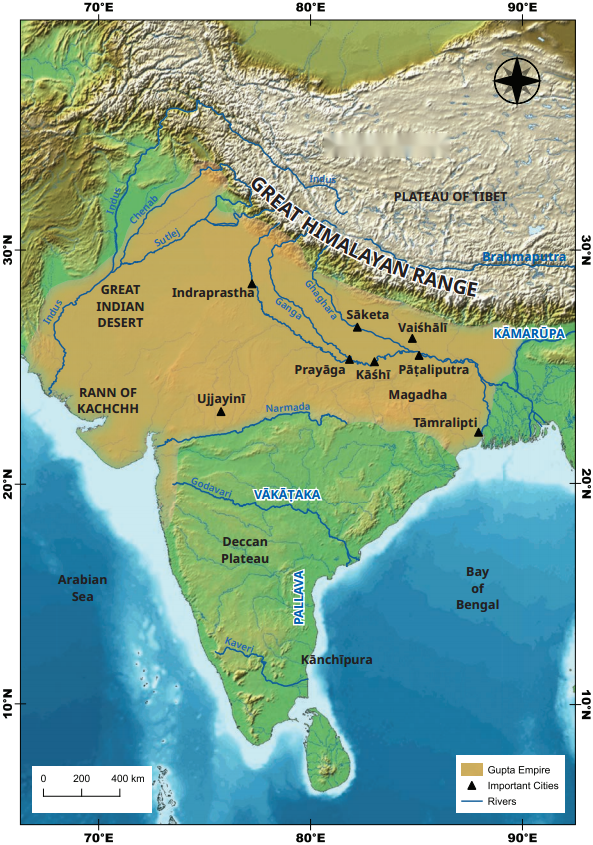
Thus, while the Gupta Empire brought unity and cultural growth in the north, other regions were also developing independently, contributing to India’s rich diversity.
Question 3
|
Their stories matter today because they showcase the intellectual and cultural achievements of ancient India. They inspire pride in Indian heritage and show how deeply rooted India’s contributions to science, literature, and the arts truly are.
II. Let’s Explore
Question 1
|
III. Think About it
Question 1
|
Question 2
|
Question 3
|
The people are numerous and happy [… J they have no need to register households or attend to officials. [ … J Those who farm royal land pay a portion of their grain. [… J The king’s guards and attendants have salaries [... J The cities are the greatest in the Middle Kingdom [i.e. the Gangetic plains J, and the inhabitants are rich, prosperous, and practice kindness and righteousness. Heads of Vaishya families [i.e. merchants or tradersJ establish houses for charity and medicines [ … J the poor, orphans and the sick are cared for [ … J doctors provide treatment, and the needy receive food and medicines. [… J The city has many wealthy Vaishya elders and foreign merchants, with beautiful homes [… J The lanes are kept in good order. -A Record of Buddhistic Kingdoms (AD 399-414) (Translated by J.Legge)
Answer:
Sample answer:
The Gupta society, as described by Faxian, was peaceful, prosperous, well-organized, with minimal state interference, a flourishing urban economy, strong values of charity, and well-maintained public infrastructure.
Question 4
|
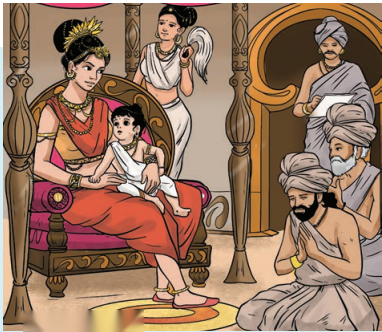
(ii) Her Posture: She is sitting confidently and with authority, possibly on a throne or elevated seat, indicating power and respect. Her calm and composed expression shows her wisdom and leadership qualities.
(iii) People Around Her: The attendants or ministers are shown in respectful positions, possibly standing or sitting lower. This shows Prabhavati Gupta was a respected ruler or regent, and others in court acknowledged her authority. The people around her also show hierarchy and roles within the court.
(iv) The Court Setting: The background is likely shown with pillars, decorations, or royal elements, reflecting the architectural style and grandeur of the Gupta period. It also hints at a well-organized court system, where rulers held discussions, judgments, and administrative duties.
These elements tell us that Prabhavati Gupta was not just a queen, but a woman of political significance, possibly ruling as a regent after her husband’s death. She lived in a time when royal women could hold power, especially in the absence of a male heir. The painting reflects a rich cultural and political life, showing the importance of women in governance during certain periods of ancient Indian history. It also highlights the glory of the Gupta era, often called the Golden Age of India, marked by prosperity, arts, and a strong administration.
The painting of Prabhavati Gupta shows her as a powerful, respected, and graceful leader in a rich and organized royal setting, reflecting her significant role in Gupta-era politics and the cultural richness of the time.
Question 5
|
(ii) You mentioned the Earth rotates on its axis. How did you figure that out?
I studied the movement of stars and planets and realized that the apparent movement of the stars is due to Earth’s own rotation. It was a radical idea then!
(iii) Can you tell us about your famous book, the Aryabhatiya?
Answer:
Certainly! The Aryabhatiya includes important ideas on arithmetic, algebra, trigonometry, and astronomy. I even gave an approximation of pi (π) as 3.1416.
(iv) Did you use zero in your mathematics?
Answer:
I used a place-value system, which made the use of zero possible, even if not the same symbol as today. This helped in simplifying large calculations.
(v) What message would you give to young learners of today?
Be curious! Question everything around you and observe nature—knowledge is everywhere if you have the patience and passion to seek it.
Group B – Interview with Varahamihira (Great Astronomer, Astrologer, and Polymath)
(i) Varahamihira ji, you were a scientist and astrologer. How did you combine both?
Answer:
I believed that science and astrology could work together. My knowledge of astronomy helped improve astrological predictions based on the movement of planets.
(ii) Can you tell us about your famous book, the Brihat Samhita?
Answer:
Of course! The Brihat Samhita is an encyclopedia. It includes information on astronomy, astrology, architecture, weather, dreams, and even perfumes!
(iii) How did you predict rainfall and weather?
Answer:
I studied cloud movements, wind patterns, and astronomical observations to forecast rainfall. It was an early form of meteorology.
(iv) What do you think about the future of science?
Answer:
I believe science is eternal. New generations must observe, record, and build on past knowledge just as I built on the work of earlier scholars.
(v) What message would you like to give us?
Answer:
Always be open to knowledge from all fields. A true scholar respects logic, observation, and the wisdom of nature.
Question 6
|
Class 7 SST Chapter 7 The Gupta Era An Age of Tireless Creativity Question Answer (Exercise)
Question 1
|
Question 2
|
Question 3
|
Socio-cultural Life: The Gupta Empire saw the rise of Hindu culture, with an emphasis on religious freedom, social harmony, and the development of educational institutions. The period also witnessed the composition of great works of literature, including the famous works of Kalidasa, such as “Shakuntala,” and the “Puranas,” which documented the history and culture of India.
Literature: This was the golden age of Sanskrit literature. Writers like Kalidasa, Aryabhata, and Varahamihira contributed significantly to the growth of literature, poetry, and scientific texts. Aryabhata, for example, made groundbreaking contributions in mathematics and astronomy during this period.
Science and Technology: Peace and prosperity allowed scholars to engage in scientific studies. Aryabhata’s work on mathematics, including the concept of zero and the approximation of pi, laid the foundation for modem mathematics. The period also saw advancements in medicine, astronomy, and metallurgy.
In conclusion, the peaceful environment fostered by Gupta rulers allowed for intellectual growth, artistic achievements, and technological advancements, making the Gupta Empire one of the most culturally rich periods in Indian history.
Question 4
|
Minister 1: Your Majesty, the people of our empire are thriving. The economy is flourishing, and trade routes from the west bring us fine silk and precious gems. However, we must focus on advancing our scientific knowledge and arts to ensure the empire remains prosperous.
Scholar 1: (Stepping forward) Your Majesty, I have been working on refining our understanding of the stars. I believe we can predict eclipses and planetary movements with more precision, which will aid our farmers and merchants.
King Chandragupta II: (Nods thoughtfully) Continue your work, Scholar. The advancement of knowledge is vital for the progress of our kingdom.
Minister 2: (Speaking excitedly) Your Majesty, we must not forget the arts. The people of our empire are artists and poets of great talent. The theater and dance are flourishing. Kalidasa’s works are already well-known, and we have much to be proud of in our cultural contributions.
Scholar 2: (With humility) We are truly blessed to live in an era where both the arts and sciences grow in harmony. I have recently completed a treatise on mathematics and am eager to share it with the court.
King Chandragupta II: (Smiling) Such knowledge will ensure that we, the children of the Gupta Empire, continue to shine brightly for generations to come. (The scene ends with an applause as the king gestures for the scholars and ministers to continue their discussions.)
Column A | Column B |
Question 1 (1)
Kanchipuram | (a) Known for vibrant cave paintings that depict the Jataka tales. |
2. Ujjayini | (b) Famous for rock-cut caves featuring intricate carvings of Hindu deities, especially Vishnu. |
3. Udayagir | (c) Capital of the Guptas. |
4. Ajanta | (d) Known as ‘a city of a thousand temples. |
5. Pataliputra | (e) A prominent centre of learning in ancient India. |
Column A | Column B |
Question 2 (1)
Kanchipuram | (d) Known as a city of a thousand temples. |
2. Ujjayini | (e) A prominent centre of learning in ancient India. |
3. Udayagir | (b) Famous for rock-cut caves featuring intricate carvings of Hindu deities, especially Vishnu. |
4. Ajanta | (a) Known for vibrant cave paintings that depict the Jataka tales. |
5. Pataliputra | (c) Capital of the Guptas. |
Question 6
Solution:
The Pallavas were a South Indian dynasty that ruled from the 4th to the 9th century CE. They were primarily based in the region of present-day Tamil Nadu, with their capital at Kanchipuram. The Pallavas were known for their contributions to art, architecture, and literature, and they played a significant role in the development of early Dravidian temple architecture. They were also patrons of Buddhism and Hinduism, and under their rule, Kanchipuram became an important cultural and religious center.
|
Question 7
|