NCERT Solutions • Class 7 Social Science (Exploring Society) |
Students can keepExploring Society India and Beyond Class 7 Solutionsand Class 7 Social Science SST Chapter 8 How the Land Becomes Sacred Question Answer NCERT Solutions handy for quick reference during exams.
Class 7 Social Science Chapter 8 Question Answer How the Land Becomes Sacred
NCERT Class 7 Social Science Chapter 8 How the Land Becomes Sacred Questions and Answers Solutions
How the Land Becomes Sacred Class 8 Question Answer (In-Text)
The Big Questions? (Page 167)
Question 1
|
Question 2
|
Question 3
|
Question 4
|
Let’s Explore
Question 1
|

Question 2
|
(a) What are your observations? Locate the route the group must have taken from Rameswaram to Haridwar. Why do you think the group was going straight to Haridwar instead of stopping at Delhi?
Answer:
Observations from the excerpt:
Route from Rameswaram to Haridwar (via Delhi):
This route essentially connects the southernmost pilgrimage site (Rameswaram) with one of the northernmost (Haridwar), showing how spiritual geography connects India across thousands of kilometres.
The group did not stop in Delhi because:
(b) In ancient times, when people were travelling from Madurai in Tamil Nadu to Varanasi in Uttar Pradesh, what languages would they come across? How would they communicate with people in those places? Where would they stay? What food would they eat? (Page 171)
Answer:
Travel in ancient times: Madurai to Varanasi People in ancient India often undertook long spiritual journeys, like from Madurai to Varanasi. Le t’s look at what that journey may have been like:
Languages encountered:
They might have communicated in the following ways:
They might have stayed at:
They have eaten:
Question 3
|
This wide geographical spread of sacred sites meant that people from all parts of the subcontinent undertook long and challenging journeys across the country. When they travelled north-south and east- west, it implied:
Question 4
|
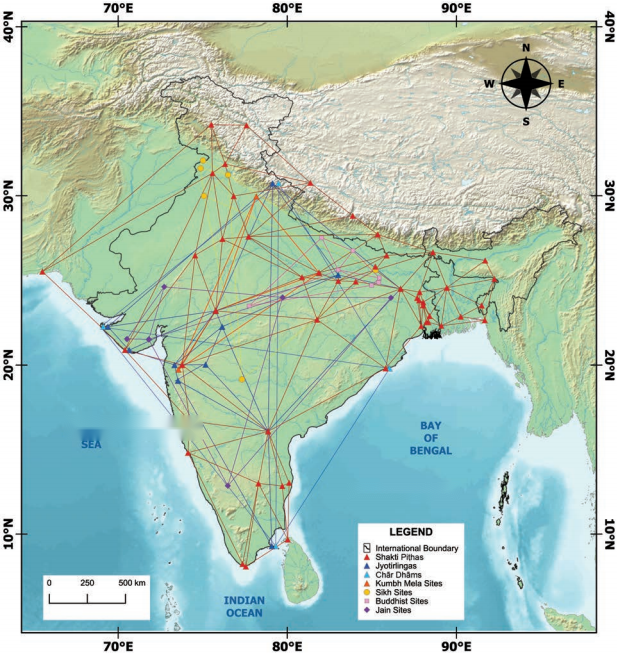

These tirthas are spread across the Indian subcontinent and represent sacred places associated with deities, legends, saints, and religious practices. They have historically played a key role in religious travel, cultural exchange, and social unity.
Question 5
|
(ii) Then, overlay the traced map on top of the map of important tirthas (sacred sites) to observe any patterns or connections between the two.
Observations:
(i) Trade routes and sacred sites alignment: Upon overlaying the maps, you might notice that many of the trade routes pass near or through important sacred places (tirthas). This could indicate a historical pattern where religious or spiritual journeys were often integrated with economic activities like trade and commerce.
(ii) Convergence of trade and pilgrimage routes: The trade routes could also coincide with pilgrimage routes, meaning that traders and pilgrims likely traveled along the same paths, leading to a mutual exchange of goods and cultural practices.
(iii) Strategic locations of tirthas: Many tirthas are located along routes that were significant for trade, such as those connecting north and south India or regions of ancient empires. This indicates that sacred places often served as resting points or cultural hubs where travelers could rest, trade, or even partake in religious activities.
(iv) Cultural and economic exchange: These overlaps between trade routes and sacred sites show how religion, culture, and economy were closely linked in ancient times, with places of worship often acting as focal points for both spirituality and commerce.
Think About it
Question 1
Solution:
Sacred places are deeply interconnected with the economic lives and activities of people in multiple ways. Some of the key connections include:
|

(i) Pilgrimage tourism: Sacred places attract pilgrims and tourists. leading to a boost in local businesses such as hotels, transport services, and local markets.
(ii) Local crafts and handicrafts: Many sacred sites have local artisans who sell handicrafts and souvenirs to pilgrims, adding to the economy of the region.
(iii) Religious donations: Temples, shrines, and pilgrimage sites often receive donations from pilgrims, which are used to fund local development, maintenance of sacred sites, and charitable activities.
(iv) Agriculture: Sacred places often have temple- owned land used for agricultural purposes, with profits sometimes directed toward charitable work or community welfare.
(v) Festivals and events: Festivals related to sacred places attract large crowds, encouraging trade, commerce, and cultural exchanges, which create a temporary boost to local economies.
(vi) Transportation and infrastructure: The movement of people towards sacred places results in the development of transportation infrastructure (roads, railways, airports), which in turn stimulates economic growth in the surrounding areas.
(vii) Cultural and religious services: Priests, performers, and guides offer their services to pilgrims, supporting the service economy in these areas.
Question 2
|
Medicinal Uses:
Ecological Benefits:
Cultural Importance:
Question 3
|

(i) Industrial waste: Factories often discharge harmful chemicals and effluents directly into the rivers without proper treatment.
(ii) Sewage and untreated waste: Many urban areas along these rivers release untreated sewage, which pollutes the water.
(iii) Religious practices: While religious rituals may involve offering flowers, idols, and other offerings into the rivers, the decomposition of these items adds to the pollution.
(iv) Deforestation: The loss of forest cover around the rivers reduces their ability to naturally cleanse and filter the water, contributing to pollution.
(v) Over-extraction of water: Overuse of river water for irrigation, drinking, and industrial needs leads to lowered water levels, exacerbating pollution. Many sacred places in local regions across India have been similarly affected by human activities:
(vi) Riverbanks: Sacred riverbanks, often the site of pilgrimages, have suffered due to littering, unregulated construction, and untreated sewage dumping.
(vii) Temples and Shrines: In some areas, temples and shrines are surrounded by litter, waste,.and encroachments, reducing their spiritual and environmental value.
(viii) Forest areas: Sacred groves or forests have been degraded due to deforestation, illegal timber harvesting, and other harmful human activities. Example: In some areas near sacred rivers, pilgrims and tourists contribute to pollution by throwing plastic waste and non-biodegradable items, impacting the sanctity of these spaces. Yes, in many regions including towns, cities, and rural areas there are sacred places that have unfortunately been polluted or degraded due to human activity. These sacred places might include temples, rivers, forests, hills, lakes, or even ancient monuments that hold religious, spiritual, or cultural significance. For example:
Preserving sacred places is a shared responsibility:
Discussion Points for Class:
Class 7 SST Chapter 8 How the Land Becomes Sacred Question Answer (Exercise)
Question 1
|
This shift in thinking can help us become better caretakers of the environment.
Question 2
|
These are considered sacred because these places are associated with ancient myths, divine presence, and stories of gods and sages. Pilgrims visit them seeking blessings, purification, and spiritual upliftment.
A short essay with the title ‘Preserving Our Sacred Places’:
Sacred places are important for our religion, culture, and environment. They include rivers, temples, forests, mountains, and lakes. In my locality, there is a holy pond near a temple that was once clean and peaceful. But now, it is often filled with garbage and plastic. I spoke to my grandparents, and they told me how people used to respect the pond and even used its water for prayers. Today, many people do not take care of such places.
It is everyone’s duty to keep sacred places clean and safe. Communities should come together to organize cleaning drives. Religious leaders can spread awareness about keeping these places pollution-free. The government should also take action against those who harm them.
Question 3
|
Question 4
|
Question 5
|
Ancient pilgrimage routes and trade:
The sacred sites help in developing the economy of the region in the following ways:
Question 6
|
Question 7
|
Varanasi (Kashi):
Amarnath (Jammu & Kashmir):
Question 8
|
CBSE 2026-27 Board Exam Preparation & Practice Papers
Free Chapter Notes & Question Bank by BoardExams.in