NCERT Solutions • Class 7 Social Science (Exploring Society) |
Students can keepExploring Society India and Beyond Class 7 Solutionsand Class 7 Social Science SST Chapter 9 From the Rulers to the Ruled Types of Governments Question Answer NCERT Solutions handy for quick reference during exams.
Class 7 Social Science Chapter 9 Question Answer From the Rulers to the Ruled Types of Governments
NCERT Class 7 Social Science Chapter 9 From the Rulers to the Ruled Types of Governments Questions and Answers Solutions
The Big Questions? (Page 185)
Question 1
|
Question 2
|
Question 3
|
Question 4
|
Let’s Explore
Question 1
|
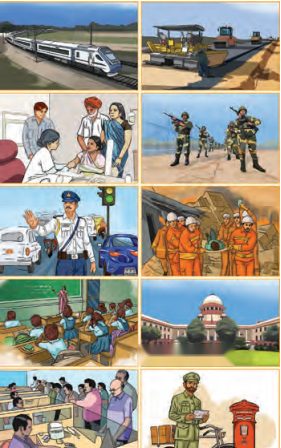
Question 2
|
Democratic process: Voting allows students to have a say in choosing their representatives, making it a democratic process. It ensures that everyone in the school has a chance to select someone they trust and believe can represent their interests.
Representation of ail grades: As mentioned by Gurpreet, if only one grade is responsible for all the tasks, they might not fully understand the challenges faced by other grades. Voting ensures that students from different grades can elect representatives who understand their specific needs and concerns.
Fairness and inclusivity: The voting method ensures fairness, as all students are given an equal opportunity to choose their representatives, avoiding bias or favouritism that might occur if the Head Teacher selects the students herself or if everyone is made to be part of the committee.
Question 3
|
Different forms of democratic government | |||
Institution | Executive | Legislature | Judiciary |
India | Prime Minister and the Council of Ministers | Lower House (Lok Sabha) is more powerful than Upper House (Rajya Sabha) | Independent executive and legislature (separation of power) |
USA | President | Equal power between Upper House (Senate) and Lower House (House of Representatives) | Independent executive and legislature (separation of power) |
South Korea | President | Single house (National Assembly) | Independent executive and legislature (separation of power) |
Australia | Prime Minister and the Council of Ministers | Prime Minister and the Council of Ministers | Independent executive and legislature (separation of power) |
A | |||
B |
(a)
Country | Executive | Legislature | Judiciary |
Country A (United Kingdom) | Prime Minister and Cabinet (Monarch is ceremonial head) | Two Houses: House of Commons is more powerful than House of Lords | Independent but Parliament is supreme (no strict separation) |
Country B (France) | President and Prime Minister share power (semi-presidential system) | Two Houses: National Assembly and Senate have legislative powers | Independent from Executive and Legislature |
(b) The similarities and differences between all the mentioned countries are as follows:
Country | Executive | Legislature | Judiciary | Type of System |
India | Prime Minister and Council of Ministers | Bicameral – Lok Sabha (more powerful), Rajya Sabha | Independent | Parliamentary Democracy |
USA | President (elected independently) | Bicameral – Senate and House (equal power) | Independent | Presidential Democracy |
South Korea | President (directly elected, holds executive power) | Unicameral – National Assembly | Independent | Presidential Democracy |
Australia | Prime Minister and Council of Ministers | Bicameral – Senate and House of Representatives (equal power) | Independent | Parliamentary Democracy |
UK | Prime Minister (Monarch is ceremonial head) | Bicameral – House of Commons (more powerful), House of Lords | Independent | Parliamentary Monarchy |
France | President (head of state) and Prime Minister (head of govt.) | Bicameral – National Assembly and Senate | Independent | Semi-Presidential Democracy |
Question 4
|
You have to form a Student Committee in your school. Make a plan and execute it in a democratic manner, ensuring that:
(i) Functions of the committee are well defined.
(ii) The election process of the committee members is democratic.
Answer:
Do it yourself.
Question 5
|
(i) Does Shane’s country look like a democracy?
Answer:
No, Shane’s country does not look like a democracy. In a democracy, people have the freedom to make choices, express opinions, and access information. In Shane’s country, all aspects of life are controlled by the government, indicating a dictatorship.
(ii) How do you think Shane’s everyday life would be?
Answer:
Shane’s everyday life would be highly restricted. He must follow strict rules about his appearance and clothing, serve in the military without a clear end, and cannot access global information. His actions are constantly monitored, leaving little to no personal freedom or privacy.
(iii) Would you like to live in such a country? Explain why.
Answer:
No, I would not like to live in such a country. Living without basic freedoms like choosing how to dress, accessing information, or expressing opinions can feel suffocating. Freedom of thought, expression, and lifestyle are important for a person’s growth and happiness, and a country that takes these away limits the development of its people.
Question 6
|
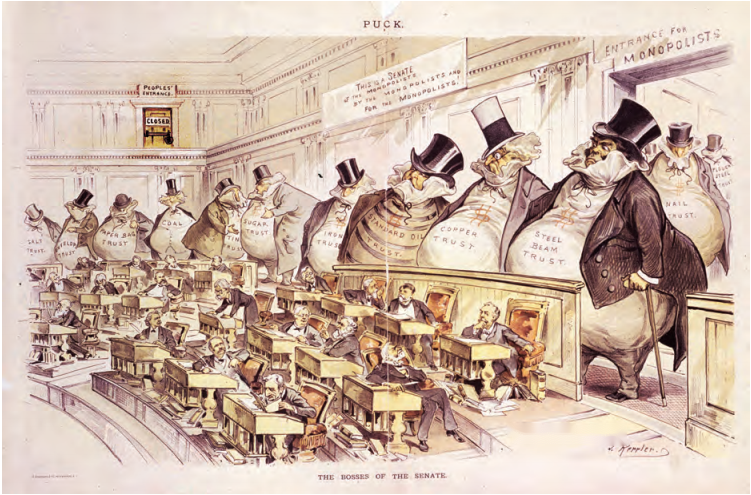
Question 7
|
Question 8
|
Think About It
Question 1
|
From the Rulers to the Ruled Types of Governments Class 7 Question Answer (In-Text)
Question 1
|
Question 2
|
Question 3
|
(i) Ensures Fairness: An independent judiciary can make decisions based on the law, not influenced by the government or any other external power. This ensures that all citizens are treated equally and fairly.
(ii) Protects Fundamental Rights: The judiciary helps protect the rights of citizens, like the right to free speech and equality before the law. If the judiciary were not independent, the government could violate these rights without anyone holding them accountable.
(iii) Checks and Balances: In a democracy, there is a system of checks and balances between the executive, legislature, and judiciary. An independent judiciary makes sure that the government’s actions do not exceed its authority or violate the Constitution.
Question 4
|
Question 5
|
Practice in the country | Type of Government |
All citizens are treated equally before law | Dictatorship |
The government refers to the religious leader for each and every decision it takes. | Monarchy |
After the queen’s death, her son became the new king. | Democracy |
The ruler is not bound to follow any Constitution. He makes all the decisions as per his choice. | Theocracy |
Practice in the country | Democracy |
All citizens are treated equally before law | Theocracy |
The government refers to the religious leader for each and every decision it takes. | Monarchy |
After the queen’s death, her son became the new king. | Dictatorship |
The ruler is not bound to follow any Constitution. He makes all the decisions as per his choice. | Democracy |
Question 6
|
Country | Type of Government |
Bhutan | |
Nepal | |
Bangladesh | |
South Africa | |
Brazil |
Country | Type of Government |
Bhutan | Democratic constitutional monarchy |
Nepal | Federal parliamentary republic |
Bangladesh | Parliamentary representative democratic republic |
South Africa | Parliamentary republic |
Brazil | Federal presidential representative democratic republic |
Question 7
|
Overcoming these hurdles involves:
Question 8
|
Democracy is different from monarchy and dictatorship. Explain.
Answer:
Democracy is different from monarchy and dictatorship in the following ways:
(i) Democracy: In a democracy, the people have the power to choose their leaders through elections. The government is formed by elected representatives, and decisions are made based on the will of the people. In a democracy, citizens enjoy fundamental rights such as freedom of speech, equality, and participation in decision-making.
(ii) Monarchy: In a monarchy, the government is ruled by a king or queen, and the position is usually passed down through generations. Monarchs have a lot of power, and in some cases, they may make all the decisions. There can be two types of monarchies: absolute (where the monarch has total power) or constitutional (where the monarch’s power is limited by a constitution or laws).
(iii) Dictatorship: In a dictatorship, one person or a small group of people hold all the power. The ruler has complete control over the government and makes decisions without the consent of the people. The rights of the people are often restricted, and there is no freedom of speech or participation in decisionmaking.
CBSE 2026-27 Board Exam Preparation & Practice Papers
Free Chapter Notes & Question Bank by BoardExams.in